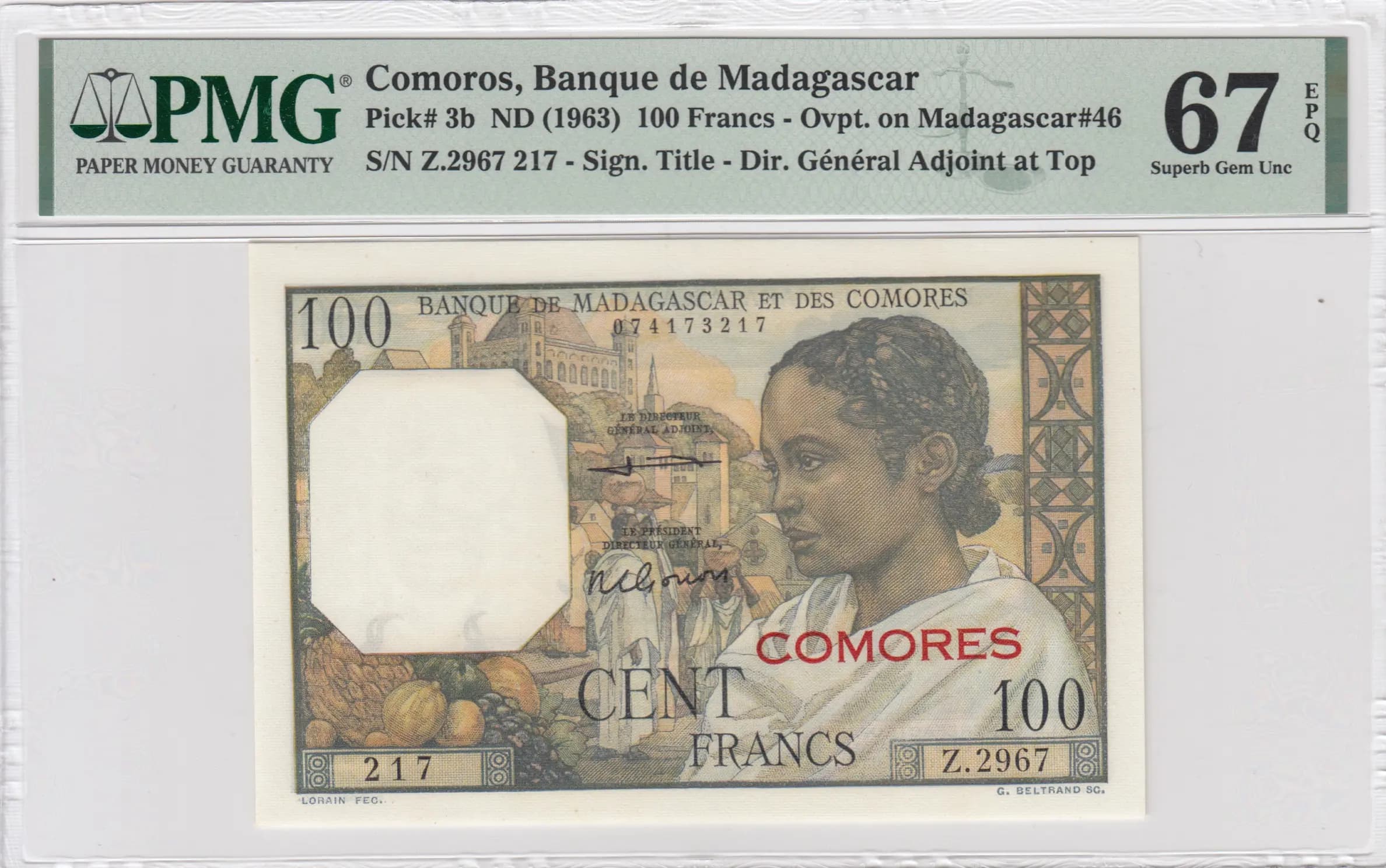
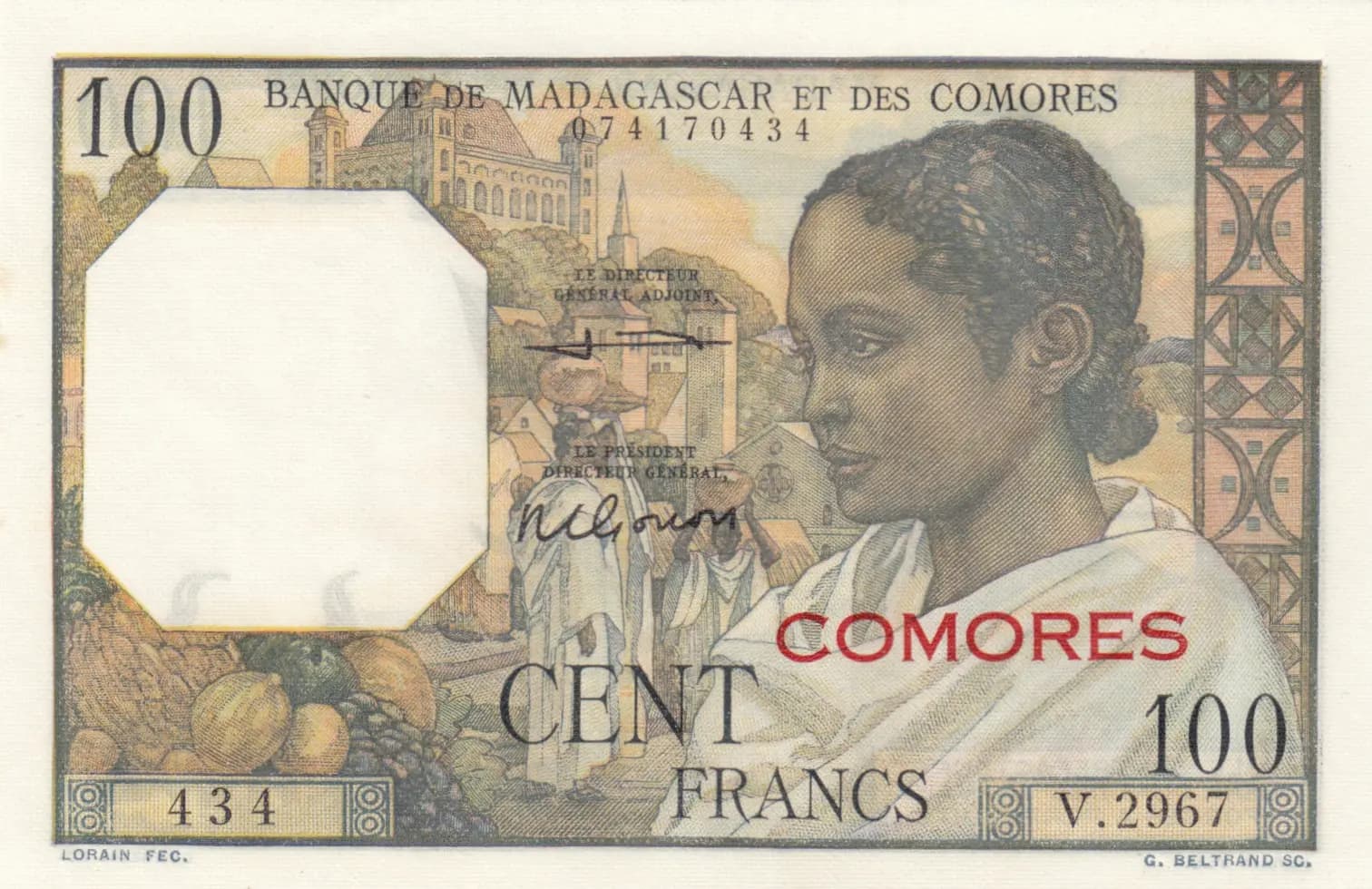
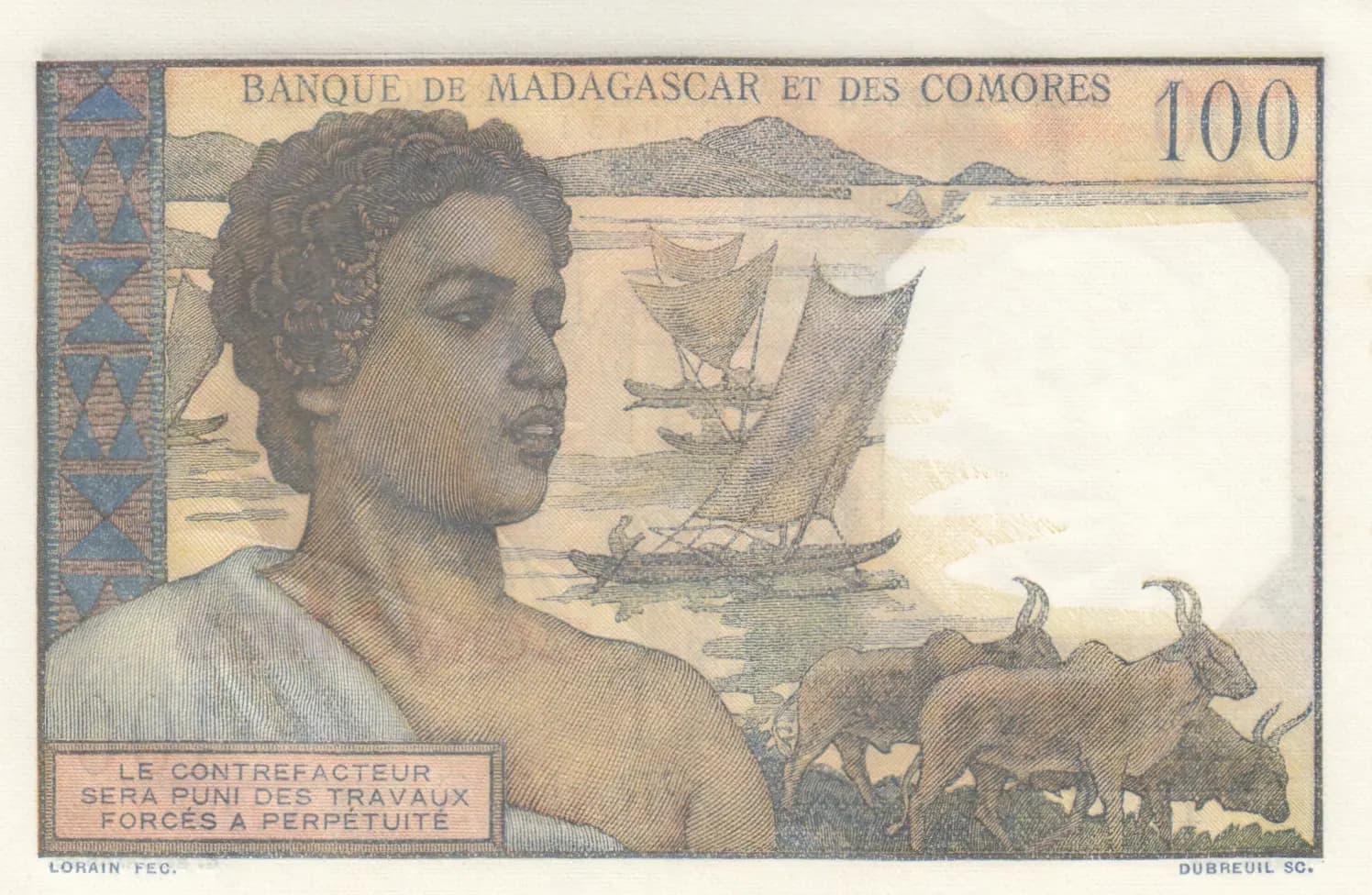
100 francs 1963
Market Prices
25 salesAbout This Note
This is a Comoros 100 Francs note from 1963, issued by the Banque de Madagascar et des Comores during the colonial transition period. The note displays the characteristic fine-line engraving of the era, with portraits on both obverse and reverse, though both sides feature large white rectangular areas of obscuration—likely indicating this is a specimen or educational example rather than circulated currency. In UNC condition with clear, sharp printing and well-preserved geometric border designs, this note represents an early post-independence African banknote of historical significance.
Common. While eBay sales data shows prices ranging from $8.60 (VG condition) to $123.50 (PMG 67), the consistent volume of sales over the 2011-2025 period and the 2019 catalogue valuation of $125 UNC indicate this is a routinely available note. The large number of graded examples in PMG population records and the frequency of auction sales confirm robust collector circulation. This is a regular issue from a colonial-era central bank with presumably substantial print runs for the Comoros territory.
Issued in 1963, this banknote represents the Comoros during the crucial period following Madagascar's independence, when the Banque de Madagascar et des Comores still served as the central banking authority for both territories. The maritime imagery on the reverse—depicting traditional sailing vessels and coastal landscape—reflects the Comoros' deep-rooted seafaring heritage and economic dependence on ocean trade. The architectural elements visible on the obverse, including cathedral-like structures, represent the colonial-era institutional infrastructure that persisted through the early post-colonial period in the Indian Ocean territories.
The 100 Francs note features dual portrait designs characteristic of colonial-era banknote production. The obverse presents a man in right-facing profile, rendered in fine engraved detail, set against an architectural background featuring colonial-era fortifications or cathedral structures with ornate towers. The reverse depicts a different man in left-facing profile, positioned above a romanticized maritime scene showing traditional Indian Ocean sailing vessels (likely outrigger or dhow-style boats) navigating coastal waters with distant mountainous terrain. Both sides employ geometric Art Deco-influenced border designs: the obverse features geometric patterns in beige, brown, and gray tones; the reverse incorporates a striking left-side border with blue diamonds and red-brown triangles. The color palette throughout combines muted earth tones with accent blues and reds, typical of 1960s banknote design. Multiple artist signatures (Lorain, Beltrand, Dubreuil) indicate production by a specialized security printing establishment.
OBVERSE: 'BANQUE DE MADAGASCAR ET DES COMORES' (Bank of Madagascar and the Comoros); 'CENT FRANCS' (One Hundred Francs); 'LE DIRECTEUR GÉNÉRAL ADJOINT' (The Deputy General Director); 'LE PRÉSIDENT DIRECTEUR GÉNÉRAL' (The President General Director); Serial number '074170434'; Artist signatures 'LORAIN FEC.' (Lorain engraved) and 'G. BELTRAND SC.' (G. Beltrand engraved). REVERSE: 'BANQUE DE MADAGASCAR ET DES COMORES' (Bank of Madagascar and the Comoros); 'LE CONTREFACTEUR SERA PUNI DES TRAVAUX FORCÉS A PERPÉTUITÉ' (The counterfeiter will be punished with hard labor for life); Artist signatures 'LORAIN FEC.' (Lorain engraved) and 'DUBREUIL SC.' (Dubreuil engraved).
Intaglio (copperplate engraving) printing, the standard security printing method for banknotes of this era. The fine-line engraving technique is evident throughout both sides, with detailed portraiture and intricate geometric borders characteristic of intaglio work. The complexity of the border designs and portrait rendering suggests production by a major European security printer, likely using the French-influenced standards prevalent in colonial African banknote production. The multiple artist signatures indicate collaborative engraving by specialized craftsmen.
This note is catalogued as Pick P-3b, with PMG records indicating P-3as and P-3b as the two known varieties. The 'b' designation typically indicates a variant difference in signatures, overprints, or other minor design elements. The red 'COMORES' overprint visible on both sides represents the Comoros-specific marking distinguishing this from the Madagascar base note (Madagascar #46). The signature titles 'LE DIRECTEUR GAL. ADJOINT' and 'LE PRÉSIDENT DIRECTEUR GAL.' are consistent with the P-3b variety designation. The white rectangular obscuration areas on both sides suggest this particular specimen may be a presentation or educational example rather than standard circulated currency.