1 peso 1946
Market Prices
18 salesAbout This Note
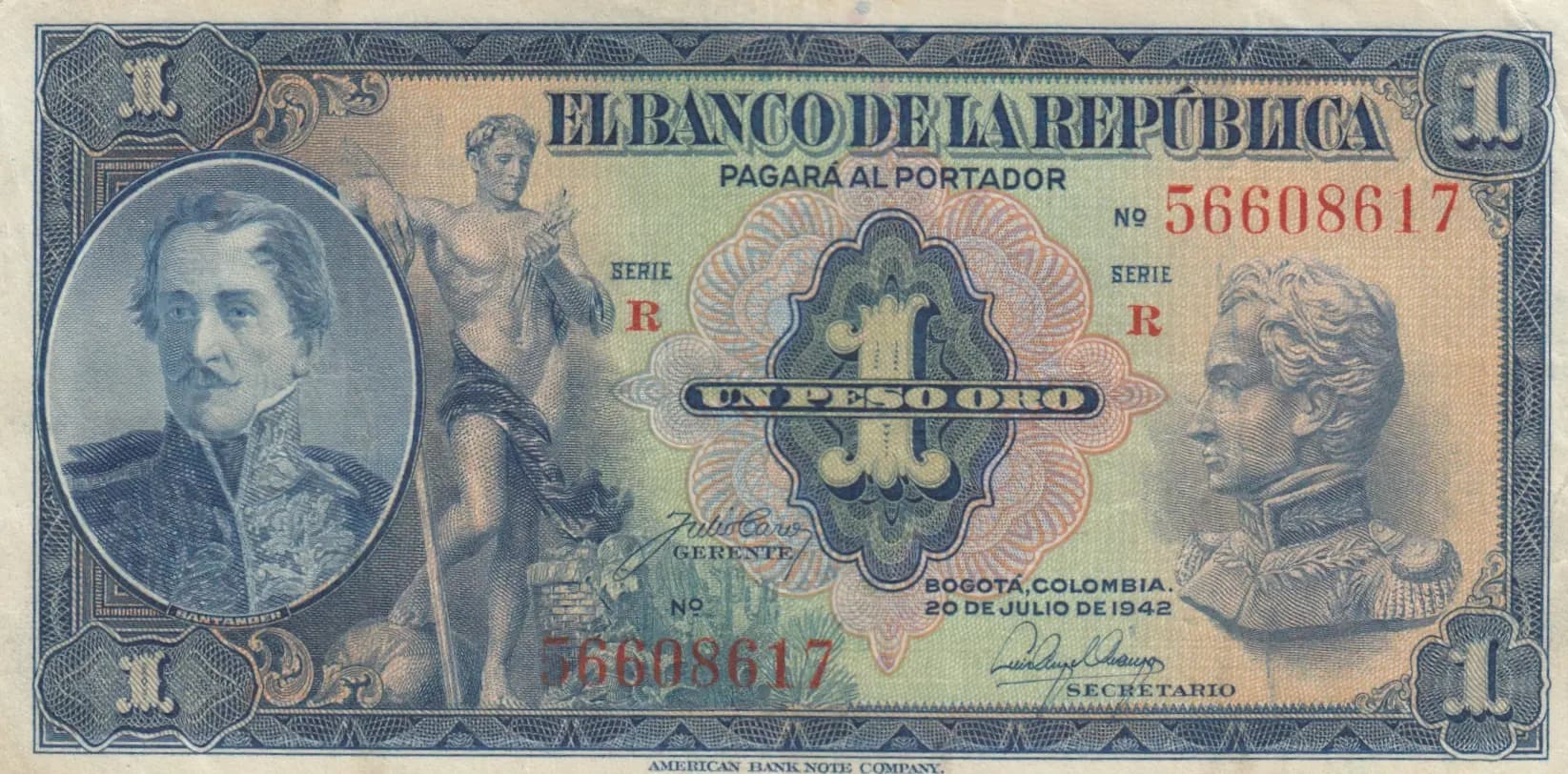
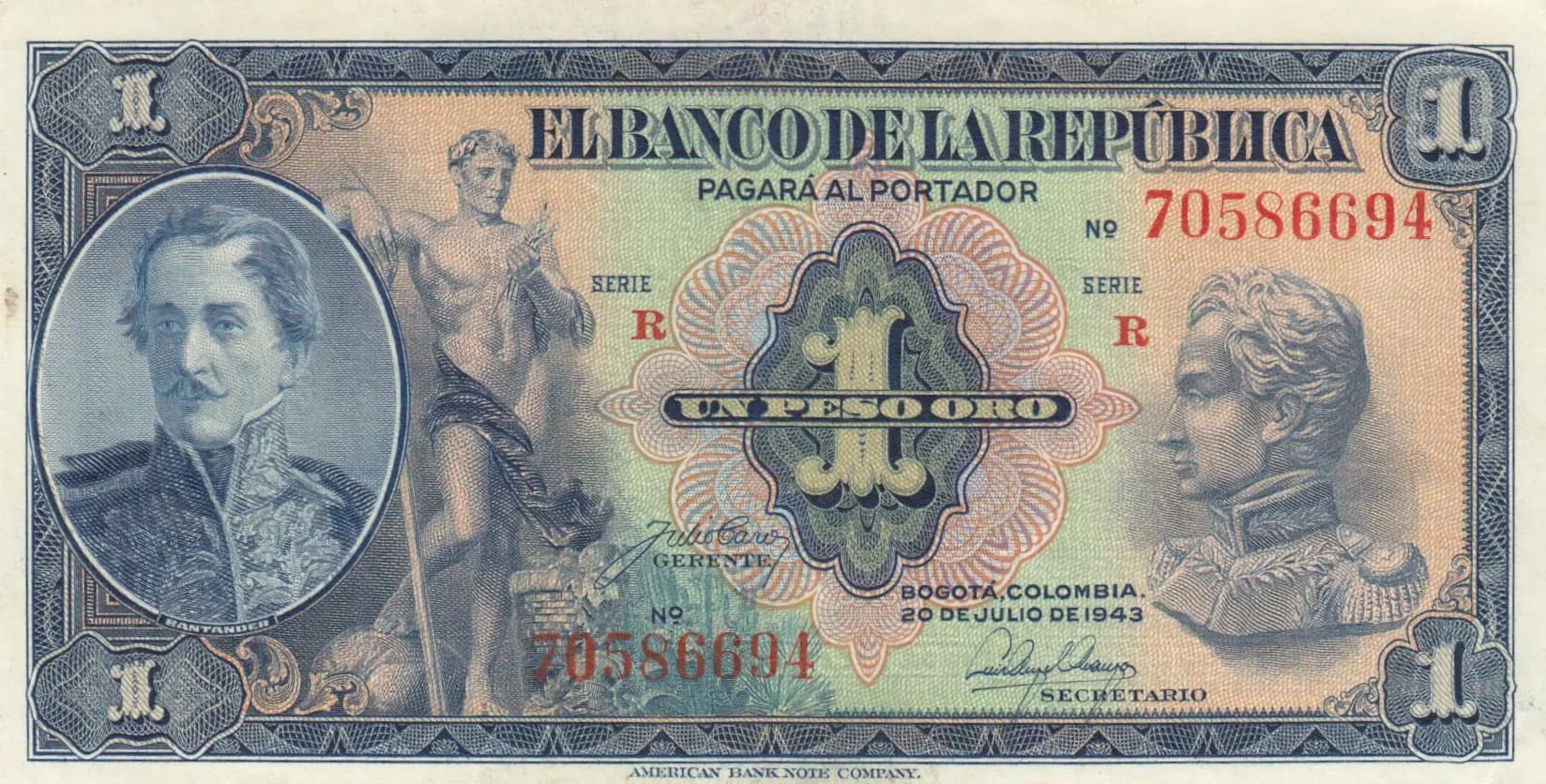
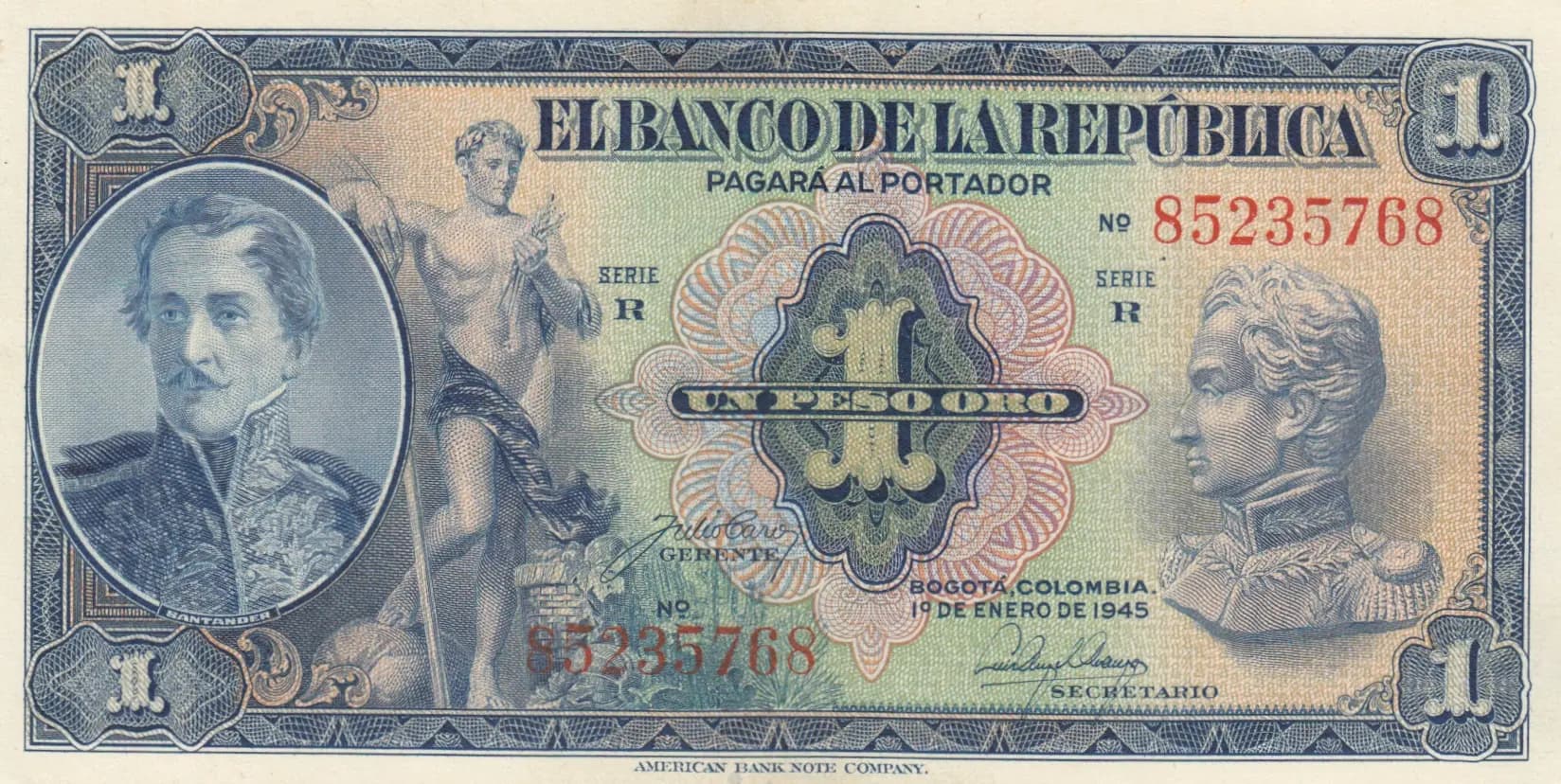
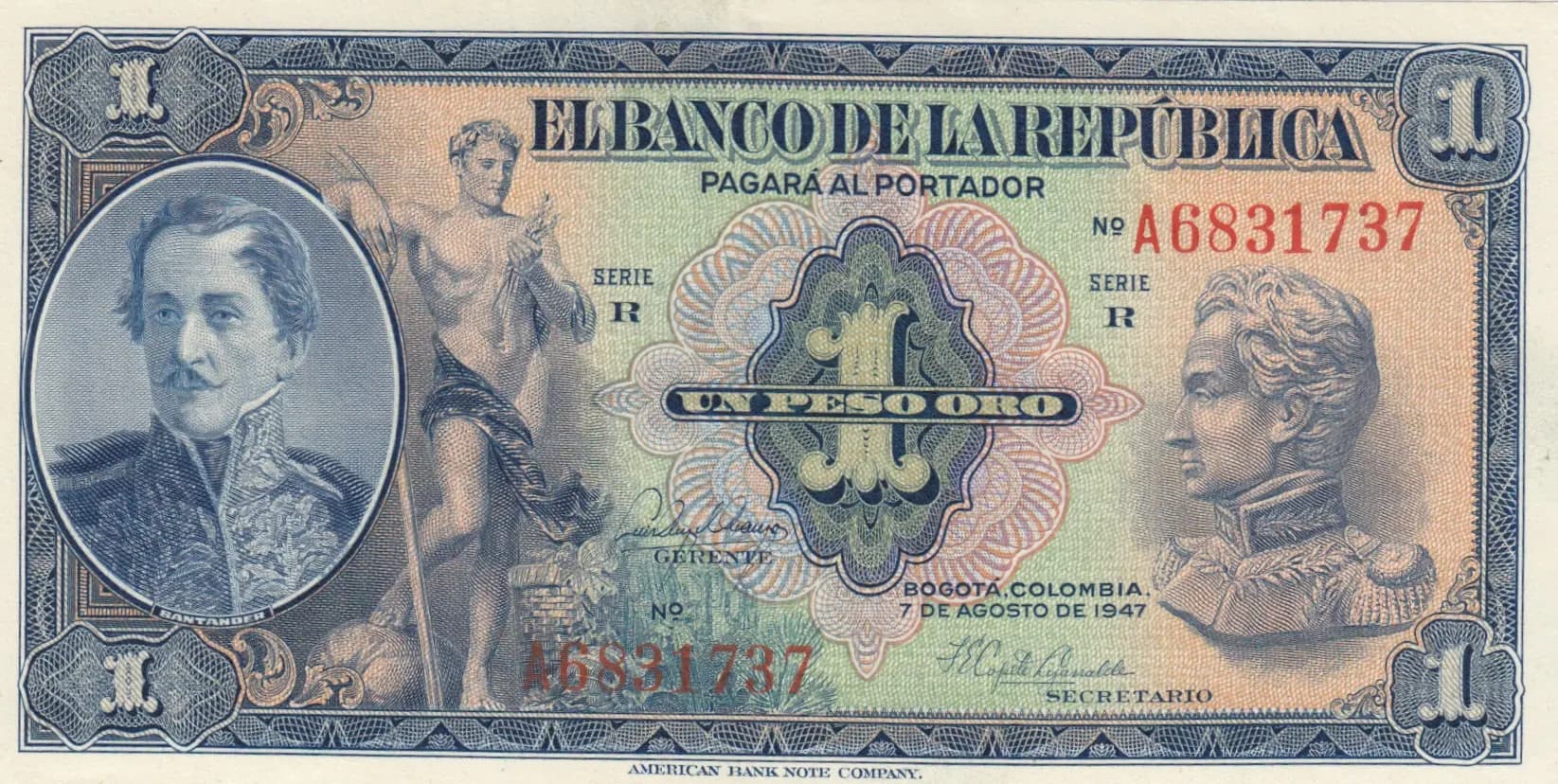
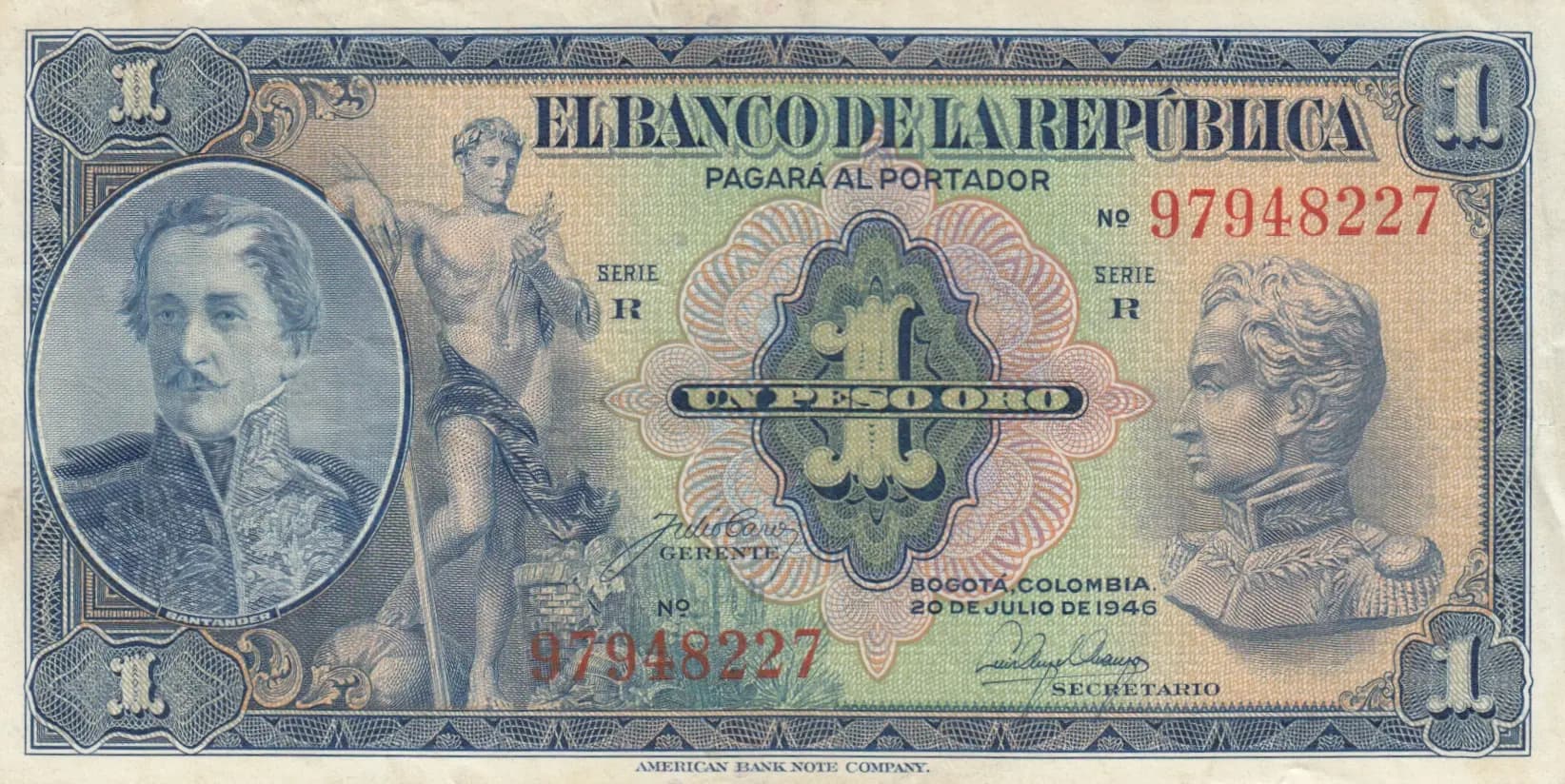
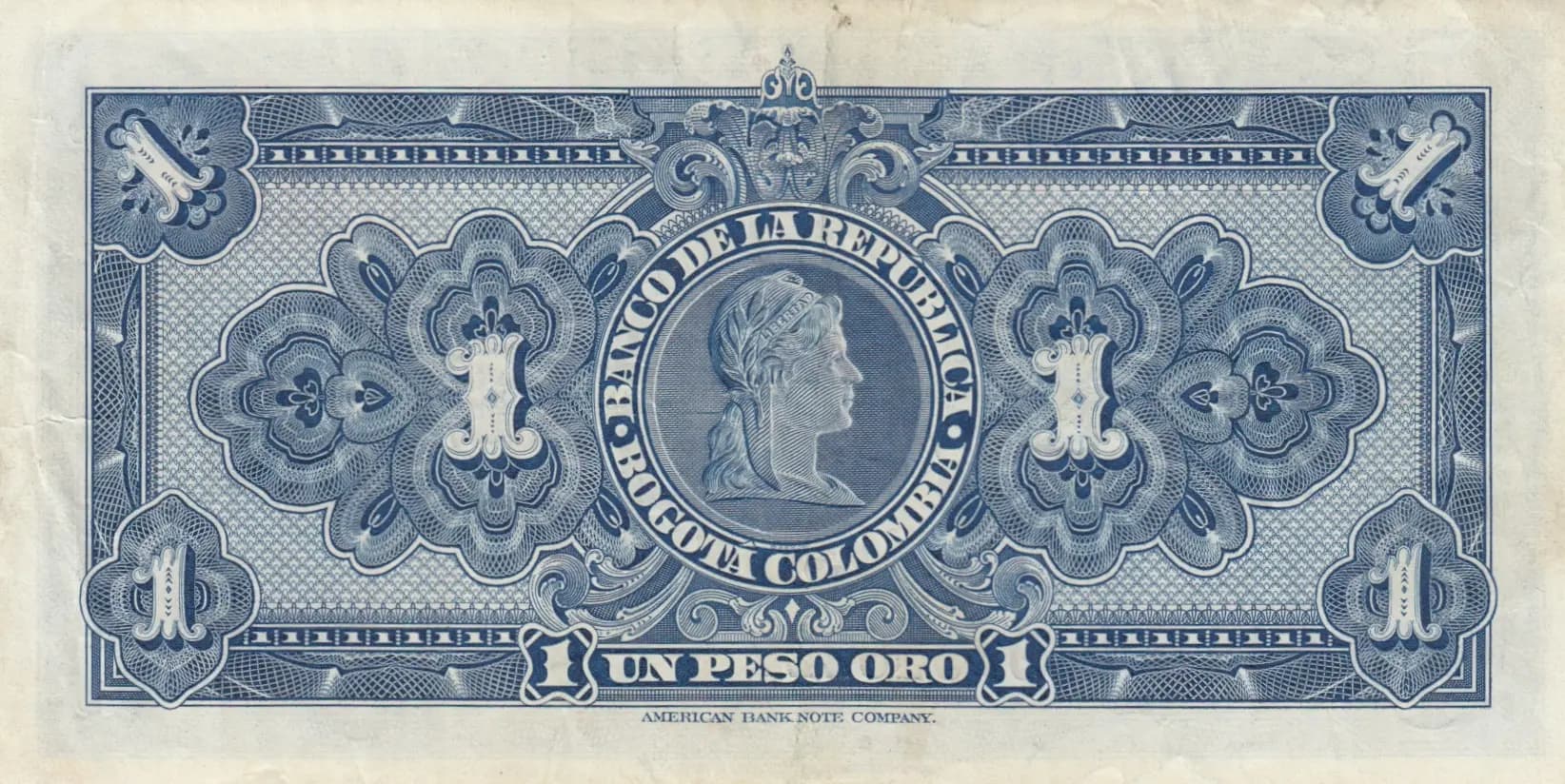
This is a 1946 Colombian 1 Peso Oro note issued by Banco de la República and printed by American Bank Note Company, graded VF (Very Fine). The note features beautifully detailed engraved portraits of General Francisco de Paula Santander and Simón Bolívar on the obverse with an allegorical female figure, while the reverse displays a classical Liberty portrait in profile. The note exhibits minimal wear with crisp printing and sharp engraving details throughout, making it an attractive example of mid-20th century Colombian currency design.
Common. eBay market data shows VF-graded examples of this note selling for approximately $15-$20 in recent years (with a 2020 VF sale at $19.99), and the 2016 catalog value for VF is only $2. The pick number P-380e represents one of five cataloged variants, suggesting moderate production quantities across the series. The regular issue designation and consistent market availability indicate this is a standard circulating issue with no significant rarity premium.
This 1946 note was issued during a pivotal period in Colombian history, commemorating two of the nation's founding fathers—Santander and Bolívar—whose portraits dominate the obverse design. The allegorical Liberty figure on the reverse reflects the democratic ideals the Banco de la República sought to project during the immediate post-WWII era. The series was produced by American Bank Note Company, New York, reflecting the close economic ties between Colombia and the United States during this period.
The obverse features two prominent portrait medallions: on the left, General Francisco de Paula Santander shown in formal attire with characteristic curled hair, and on the right, a profile bust of Simón Bolívar. Between these historical figures stands an allegorical female representation of Justice or Liberty bearing a scepter, symbolizing the rule of law and republican values. The reverse displays a classical female portrait in profile within an ornate circular medallion, representing Liberty—a common motif in Colombian currency design of this era. Both sides are framed by intricate geometric borders with floral scrollwork, fleur-de-lis designs, and shield elements, typical of the refined aesthetic ABNC applied to Latin American issues. The denomination 'UN PESO ORO' appears prominently in multiple locations.
FRONT: 'EL BANCO DE LA REPÚBLICA' (The Bank of the Republic) / 'PAGARÁ AL PORTADOR' (Will pay to bearer) / 'UN PESO ORO' (One Peso Oro) / 'SERIE R' (Series R) / Serial number: 97948227 / 'BOGOTÁ, COLOMBIA' (Bogotá, Colombia) / '20 DE JULIO DE 1946' (July 20, 1946) / 'SECRETARIO' (Secretary) / 'AMERICAN BANK NOTE COMPANY' (printer identification). BACK: 'BANCO DE LA REPÚBLICA' (Bank of the Republic) / 'COLOMBIANA' (Colombian) / 'UN PESO ORO' (One Peso Oro) / 'AMERICAN BANK NOTE COMPANY' (printer identification).
Intaglio engraving (steel or copper plate engraving), the standard security printing method for currency of this period. The visual analysis confirms the characteristic fine line work, cross-hatching, and intricate detail that defines intaglio production. American Bank Note Company, New York, was renowned for this technique and applied it consistently across their international banknote commissions. The note exhibits the sharp, crisp impression and fine detail work typical of high-quality ABNC production from the 1940s.
This note is cataloged as P-380e variant. The visual analysis identifies Series R with serial prefix visible. According to the external reference data, prefixes A-F were used for the 1946 issue. The specific date of July 20, 1946 appears on this example. The note belongs to the standard 1929-1954 issue period, during which multiple variants (P-380a, P-380b, P-380e, P-380g, P-380s) were produced. Without access to comparative images of other P-380 variants, the specific distinguishing characteristics of the P-380e variety cannot be definitively stated from this single example, though it may relate to date, signature, or minor design variations.