500 custom gold units 1947
Market Prices
21 salesAbout This Note
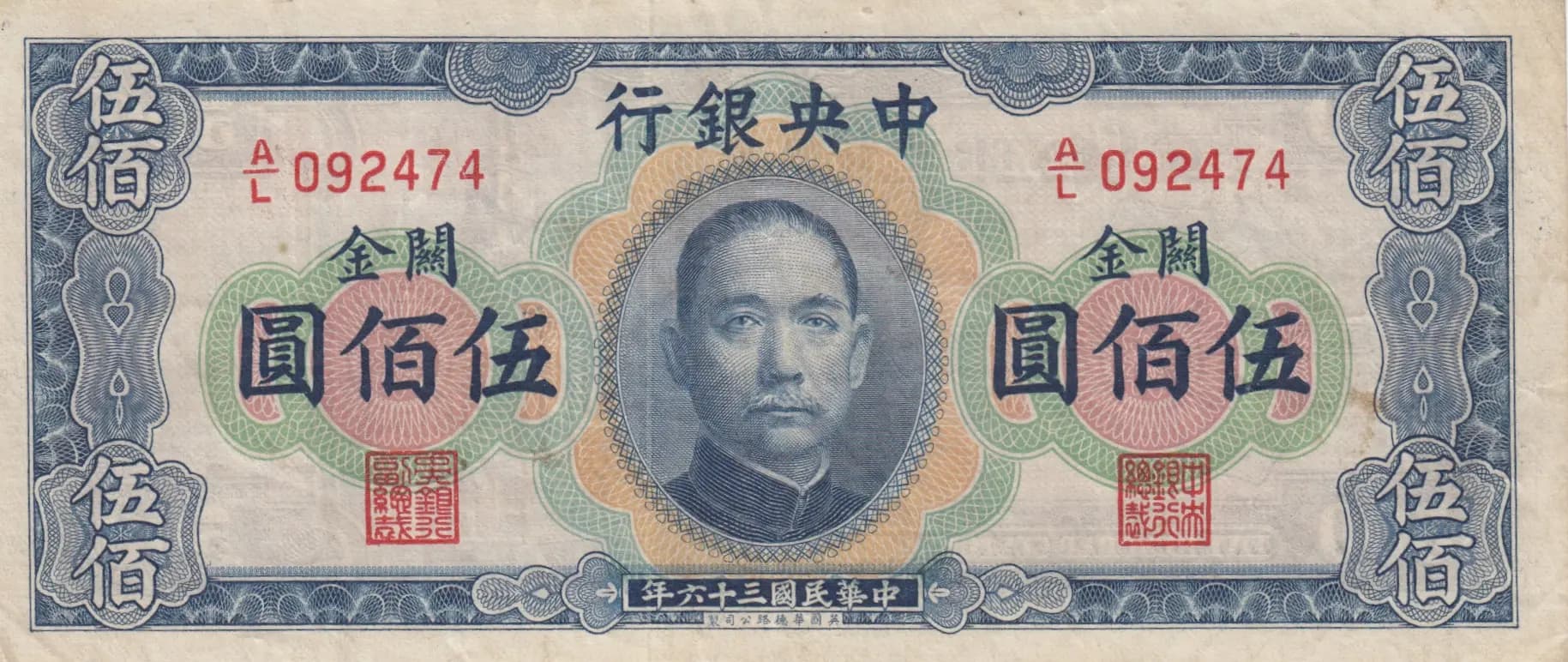
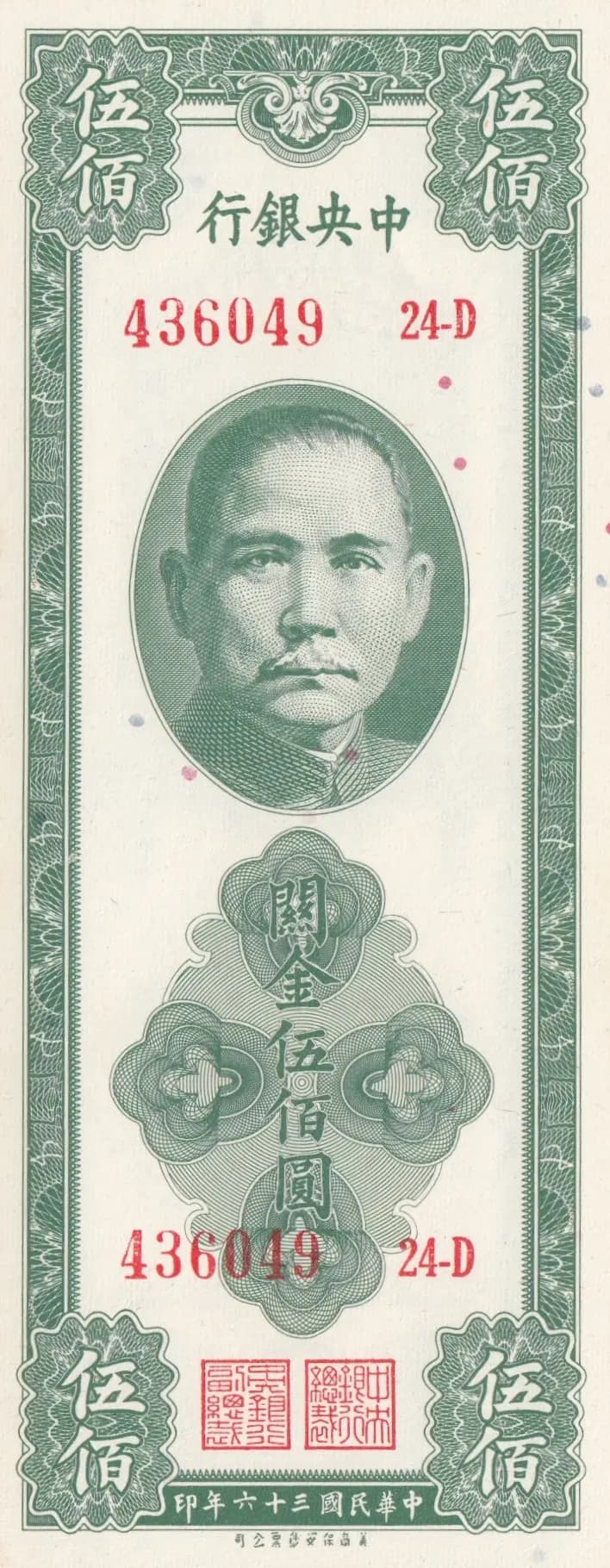
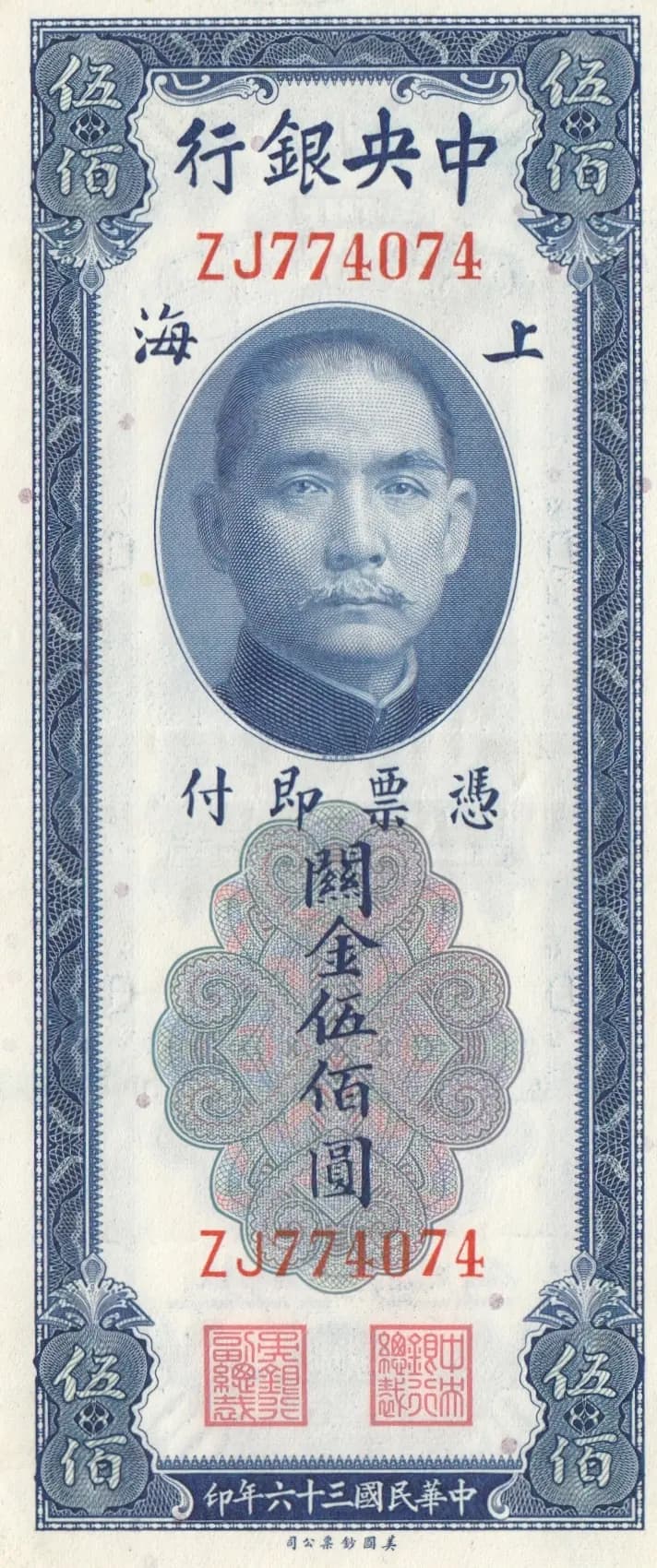
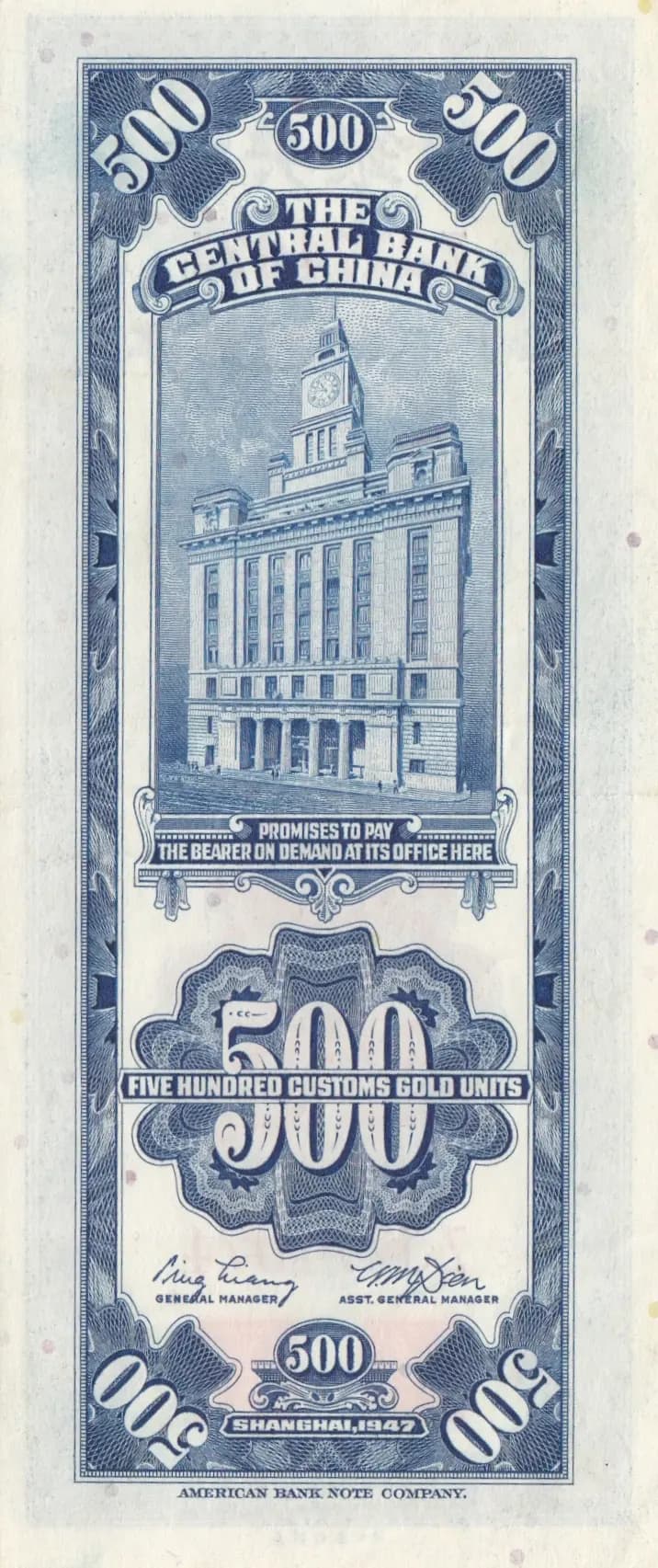
This is a 1947 Central Bank of China 500 Customs Gold Units note (Pick P-335) in circulated condition, featuring a formal portrait of a dignitary in an ornate oval frame on the obverse and an impressive neoclassical government building with clock tower on the reverse. The note exhibits typical aging characteristics including foxing and light staining consistent with 75+ years of storage, with serial number ZJ774074 visible in red ink. As a product of the American Bank Note Company's Shanghai operations during the final years of the Republic of China, this represents an important transitional-period currency before the Communist takeover.
Common. While this is a transitional-period note from 1947, the eBay sales history demonstrates consistent availability at modest prices ranging from $1.99 to $120 depending on condition grade and certification level. A PMG 64 specimen sold for $39.99 in November 2025, and the 2016 catalog value for UNC condition is only $12.50. The frequency of sales across multiple years and the wide range of grades appearing on the market indicate substantial print runs and good availability, typical of regular issue notes from the Central Bank of China. The note is historically interesting but not scarce.
This banknote was issued during 1947, the final full year of the Nationalist Chinese government's control before the Communist victory in 1949, representing the Central Bank of China's attempt to stabilize currency through the Customs Gold Unit standard. The architectural landmark depicted on the reverse—a prominent government building with clock tower—symbolizes the institutional authority of the Republic of China's financial system during this turbulent period. The bilingual English-Chinese inscriptions and American Bank Note Company imprint reflect the Western-oriented financial practices and foreign expertise that characterized Nationalist China's banking infrastructure in its final years.
The obverse features a central oval portrait of what appears to be a senior government or banking official in formal dress with high collar, rendered in classical engraving style. The note is dominated by blue coloring with ornate borders incorporating traditional Chinese decorative elements including cloud scroll patterns and corner ornaments. Two red official seals appear at the bottom, providing authentic governmental validation. The reverse displays a neoclassical institutional building—likely the Central Bank of China headquarters or a major financial institution in Shanghai—featuring symmetrical architecture, prominent clock tower, columned entrance, and arched details. The denomination '500' appears in multiple locations in ornate cartouches, with bilingual text in English and Chinese characters. The overall design reflects the hybrid aesthetic typical of Republican-era Chinese currency, blending Western banking security practices with traditional Chinese artistic elements.
OBVERSE: 中央銀行 (Central Bank), 上海 (Shanghai), 惠票愿付 (Redeemable on demand), 關金佰埧圓 (Customs Gold Units Yuan), 中華民國三十六年 (Republic of China Year 36 [1947]), Serial number ZJ774074. REVERSE: THE CENTRAL BANK OF CHINA, FIVE HUNDRED CUSTOMS GOLD UNITS, SHANGHAI, 1947, PROMISES TO PAY THE BEARER ON DEMAND AT ITS OFFICE HERE, AMERICAN BANK NOTE COMPANY, Signatures: Hao Deng (General Manager), Yung Tsan (Assistant General Manager), Denomination: 500 (marked in four corners and multiple cartouches).
Intaglio/engraving, as evidenced by the fine line work, ornate border designs, and detailed architectural imagery characteristic of security printing. The printer is identified as the American Bank Note Company (ABNC), Shanghai operation, which was one of the world's leading security printers and produced many Chinese banknotes during the Republican period. The use of multiple colors (blue, red, white) and sophisticated anti-counterfeiting elements such as the engraved borders and fine-line denominations are consistent with high-security intaglio production standards.
This specimen features serial number ZJ774074 with the 'ZJ' prefix. The note is signed by Hao Deng (General Manager) and Yung Tsan (Assistant General Manager), representing the standard authorization signatures for this issue. The visible condition shows moderate circulation wear with foxing, consistent with stored but not heavily circulated examples of this series. No major varieties (such as signature varieties or overprints) are evident in this specific specimen, though the Chinese Republican period is known to have multiple signature and date varieties across the Central Bank's output.