10 dollars 1923
Market Prices
6 salesAbout This Note
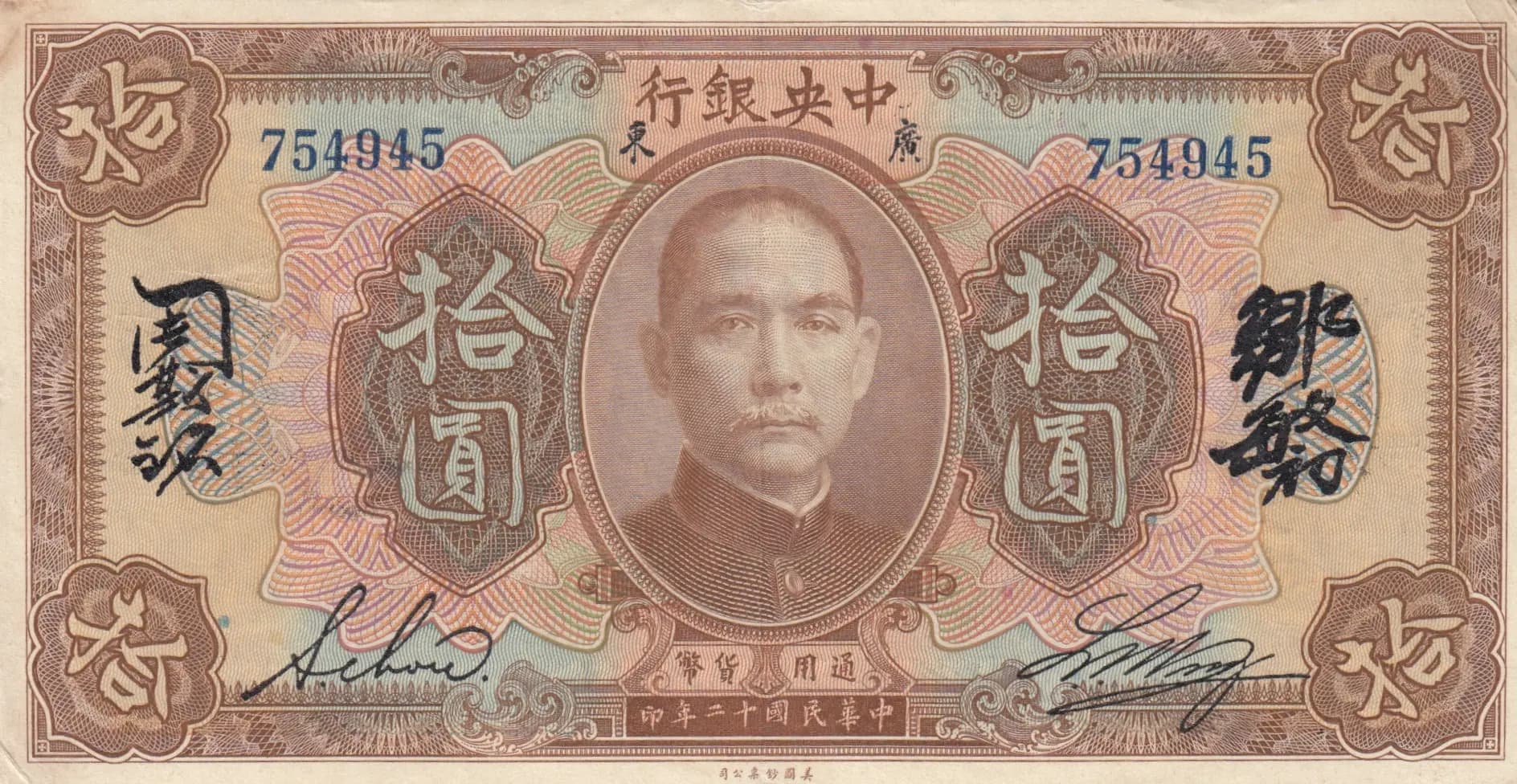
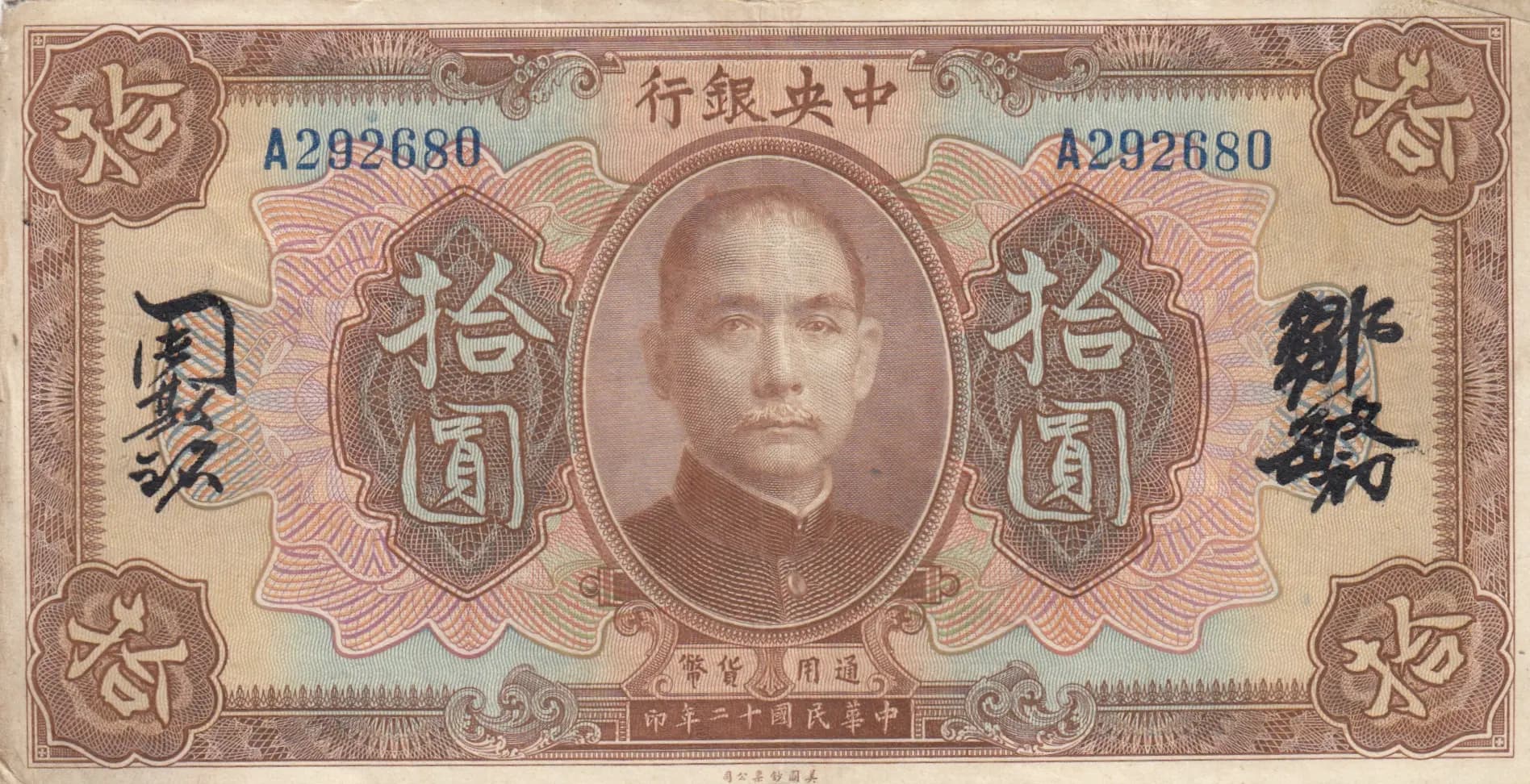
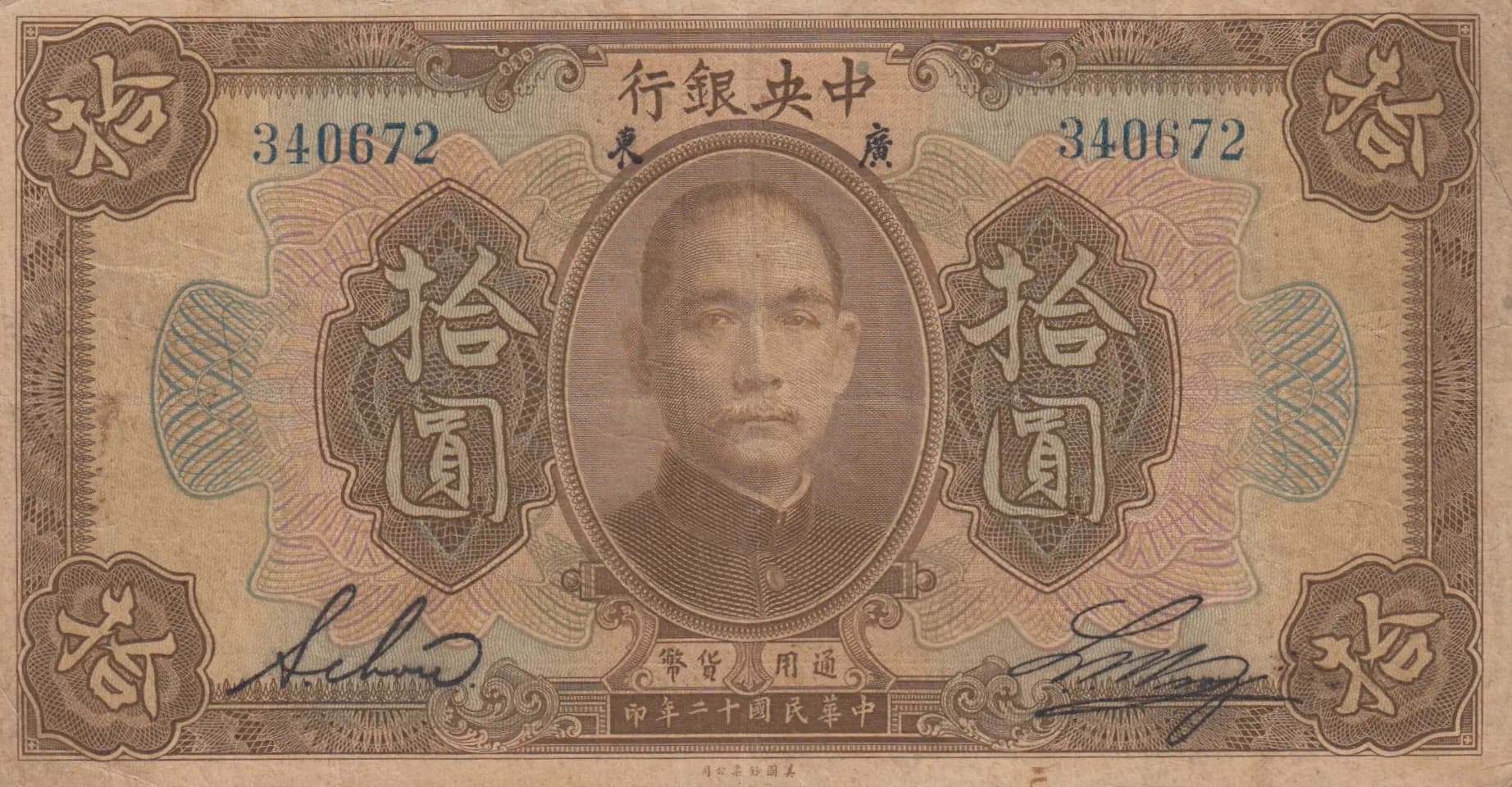
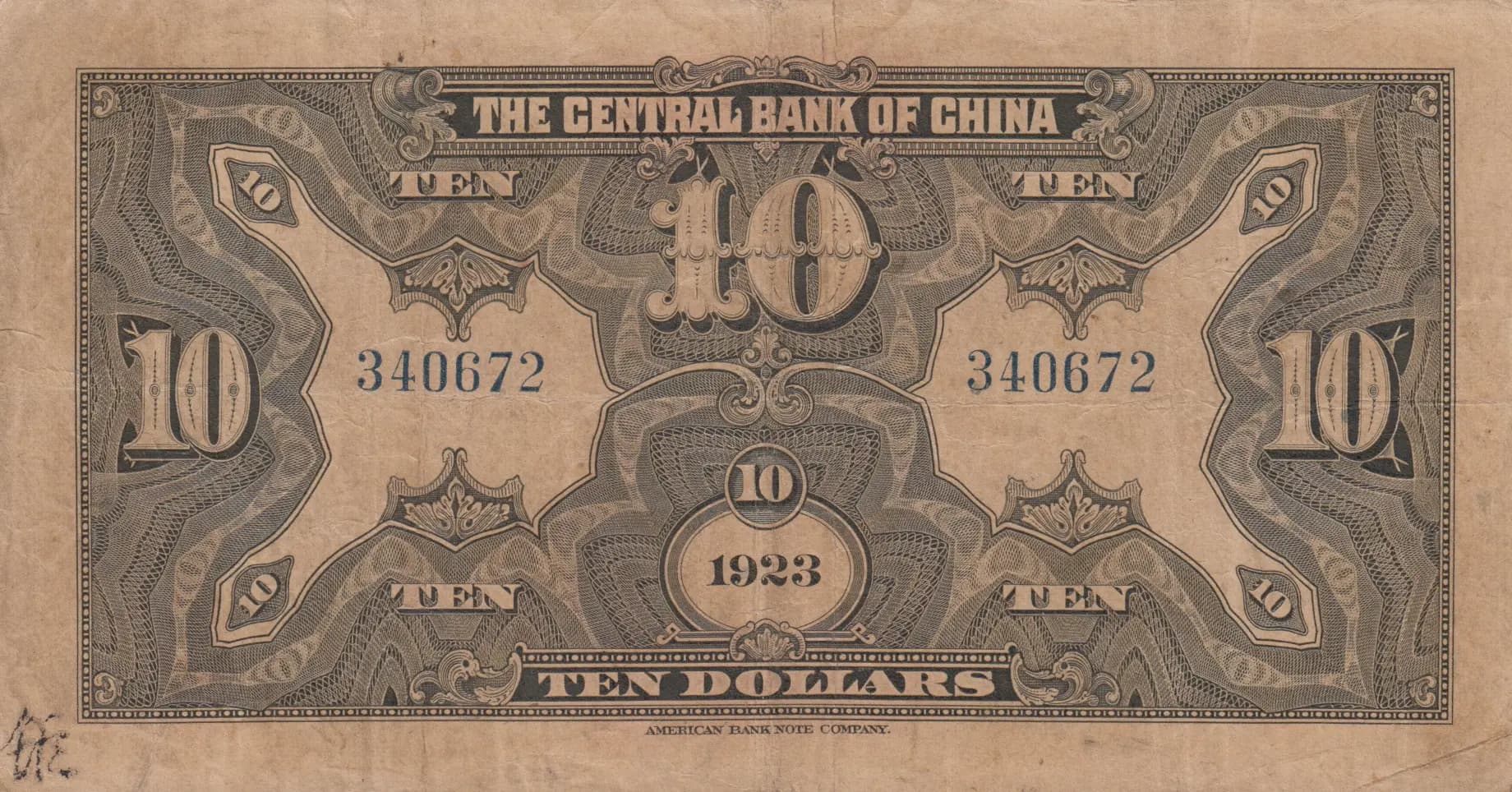
This is a 1923 Central Bank of China 10 Dollar note (Pick P-176a) in Fine condition, printed by the American Bank Note Company. The note features a distinguished portrait of Sun Yat-sen in formal military dress centered within an ornate oval medallion, surrounded by traditional Chinese decorative elements and dragons. The tan-beige aged patina, visible creasing, and foxing are consistent with genuine early 20th-century circulation, making this an authentic example of early Republican-era Chinese currency.
Common. While eBay market data shows modest prices ($3-$15 range for Fine condition), this reflects the general collector market for early Chinese Republican currency rather than rarity. The note was produced by ABNC in standard quantities for regular circulation, and multiple examples regularly appear on the market. The Fine condition grade specified is a normal, frequently encountered state for this era of currency. No evidence of limited print runs, recalls, or short-lived issuance supports a rarity designation.
Issued during the early years of the Republic of China (1912-1949), this 1923 note represents a transitional period when the fledgling nation sought international legitimacy by engaging the American Bank Note Company for currency production. The prominence of Sun Yat-sen's portrait reflects his role as the founding father of the Republic, while the bilingual English/Chinese inscriptions demonstrate China's engagement with Western financial institutions and the international banking system of the era. The Kwangtung (Guangdong) overprint indicates regional authorization, reflecting the decentralized nature of Republican-era Chinese banking.
The obverse features Sun Yat-sen (1866-1925), founder of the Republic of China, depicted in formal military-style dress with high collar within an ornate oval portrait medallion. The design is framed by elaborate decorative corner medallions containing Chinese characters, shield-shaped ornamental frames flanking the portrait, and intricate floral scrollwork and geometric patterns characteristic of early 20th-century security printing. The reverse displays symmetrical ornamental design with dragon imagery in central and corner medallions, traditional Chinese architectural motifs, crown and shield designs, and repeating floral scrollwork. Both sides maintain the bilingual aesthetic (English and Traditional Chinese characters) consistent with the Central Bank of China's international positioning during the Republican period.
FRONT SIDE: '中央銀行' (Central Bank); '中華民國通用貨幣' (Currency in General Circulation of the Republic of China); '東廣' (East Guangdong/Kwangtung overprint); Serial number 340672. BACK SIDE: 'THE CENTRAL BANK OF CHINA' (English); 'TEN DOLLARS' (English); 'YUAN' (currency unit designation); '10' (denomination numeral); '1923' (issue year); 'AMERICAN BANK NOTE COMPANY' (printer credit); Serial number 340672 matching front.
Intaglio engraving, the standard security printing method used by the American Bank Note Company (ABNC) for high-security currency production. The detailed line work visible in the portrait, the fine geometric patterns throughout, and the complex ornamental borders characteristic of intaglio engraving are all evident in the visual analysis. ABNC was contracted as the official printer for this issue, utilizing their expertise in anti-counterfeiting techniques through multi-color overprinting and intricate engraved designs.
This specific example exhibits the Kwangtung (廣東) overprint in Chinese characters at upper left and right center on the obverse, which is the defining characteristic of Pick P-176a. The serial number 340672 in blue and the English signature are present as documented for this variety. The note measures approximately 152 x 76mm as specified for the overprinted variety, distinguishing it from non-overprinted issues (P-176) that may vary slightly in dimensions.