50 ringgit 1967 specimen
Market Prices
About This Note
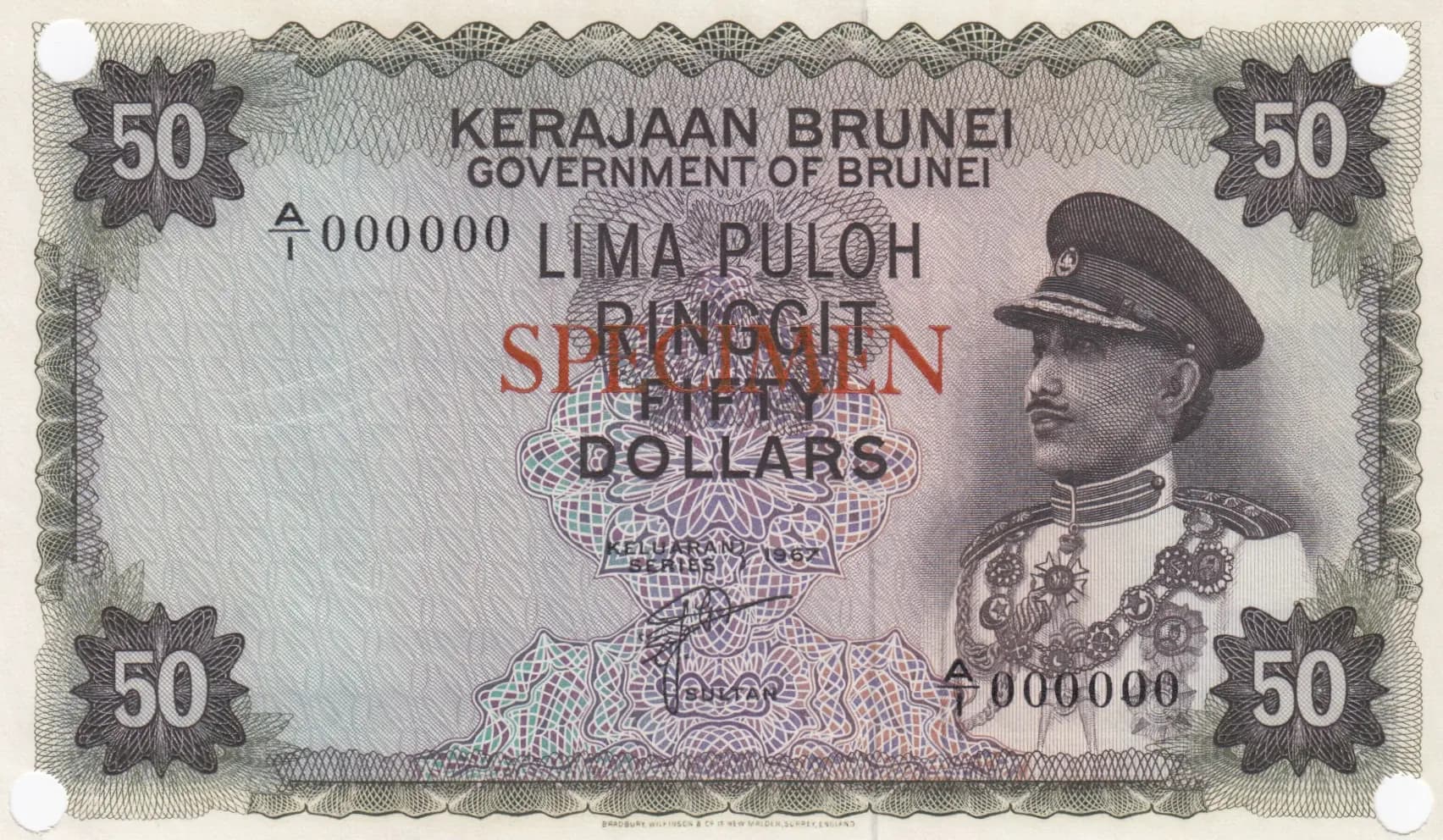
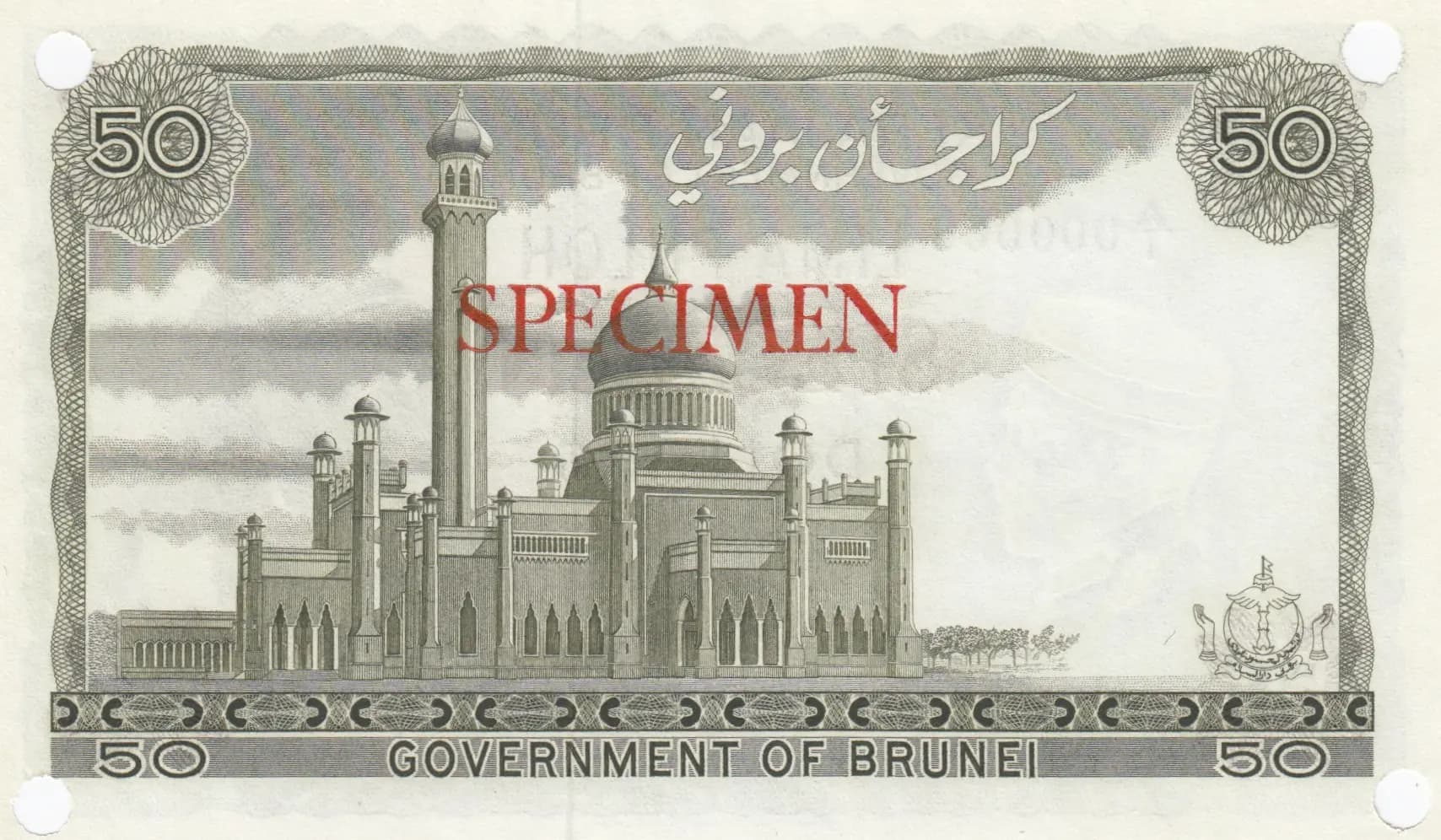
This is an exceptional specimen example of Brunei's 1967 50 Ringgit banknote, struck in uncirculated condition with pristine clarity throughout. The note displays the formal portrait of Sultan Omar Ali Saifuddin III in military dress on the obverse, paired with a masterfully engraved reverse depicting the Sultan Omar Ali Saifuddin Mosque in Bandar Seri Begawan. As a specimen note marked for non-circulation, this represents an important early issue from Kerajaan Brunei's first modern currency series, making it a prized item for collectors of Southeast Asian numismatics.
Common. This 1967 50 Ringgit specimen note, while historically significant, exists in sufficient quantities to be considered common in the collector market. eBay transaction data provided shows highly variable pricing ($1.99 to $195.00 USD), but the majority of listed UNC examples cluster in the $50-$65 range, with many selling below $25. This price volatility and relatively accessible market availability, combined with the routine production of specimen notes by security printers for archival and demonstration purposes, indicate this is a common note despite its official designation and historical value. The specimen overprint does not significantly restrict circulation or rarity among collectors.
This 1967 specimen note marks a significant moment in Brunei's monetary independence, issued during the reign of Sultan Omar Ali Saifuddin III, who reigned from 1950-1967. The prominence of the Sultan in military regalia reflects his role as both the political and military leader of Brunei, while the depiction of the mosque bearing his name on the reverse underscores the Islamic foundation of the sultanate's governance and cultural identity. This early series preceded Brunei's full independence in 1984 and represents the nation's assertion of sovereign monetary authority in the mid-20th century.
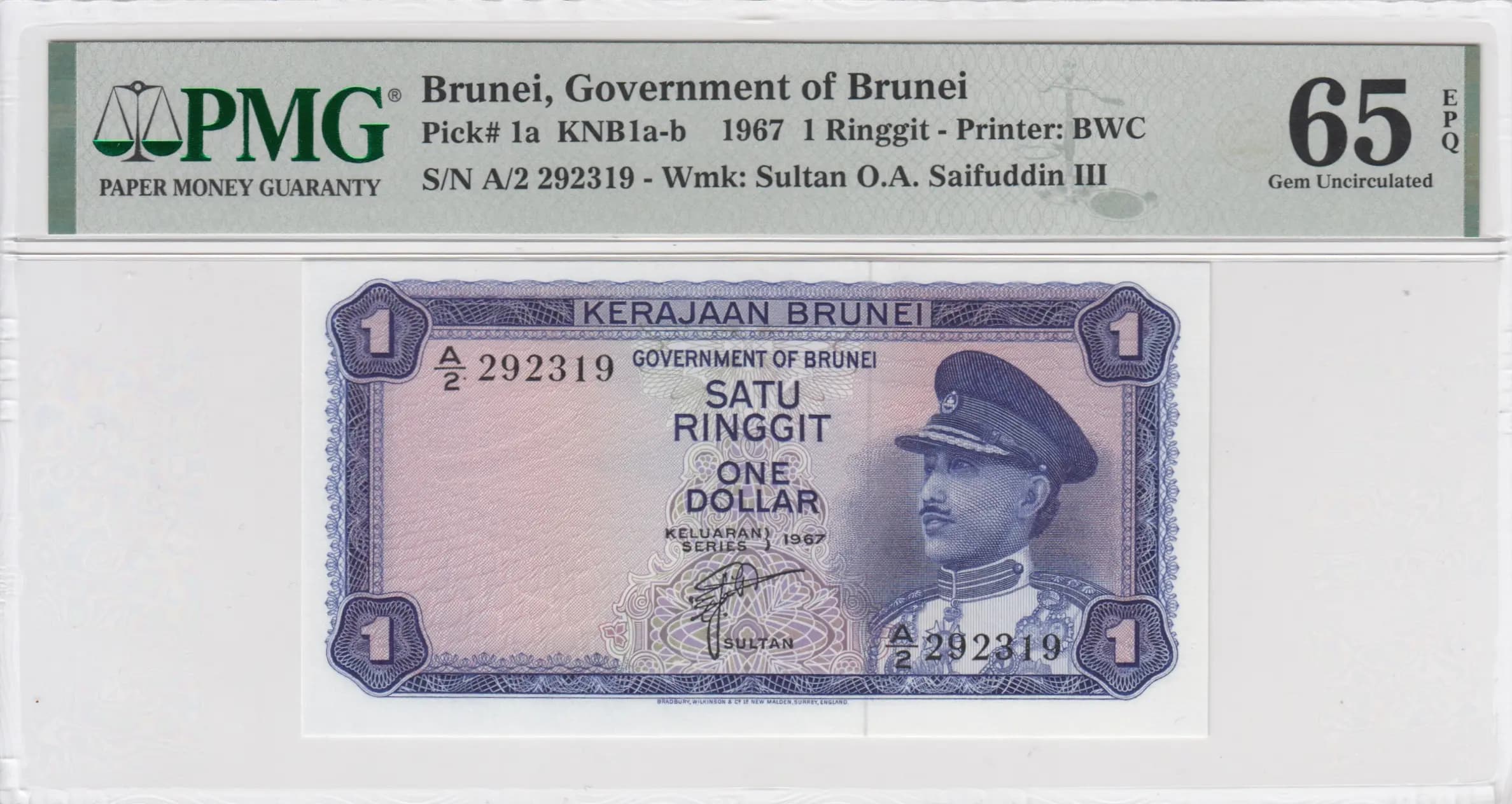
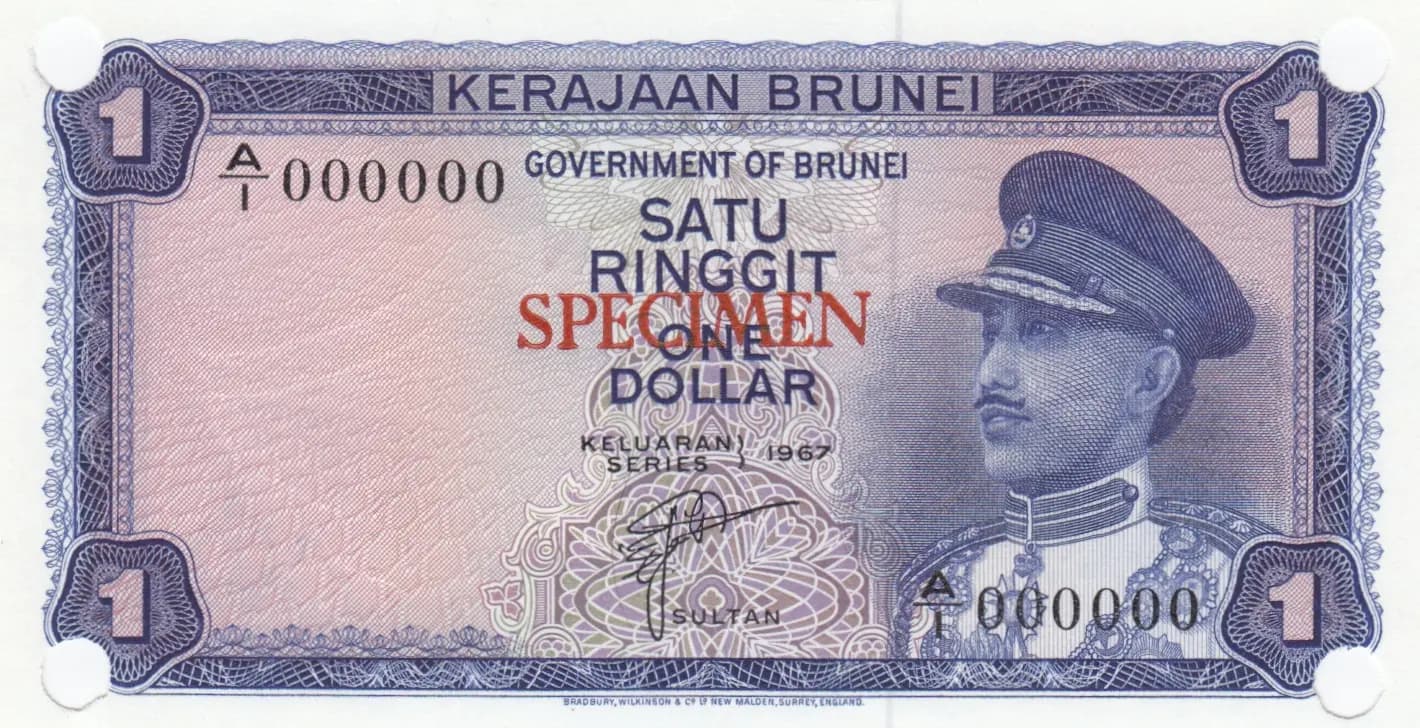
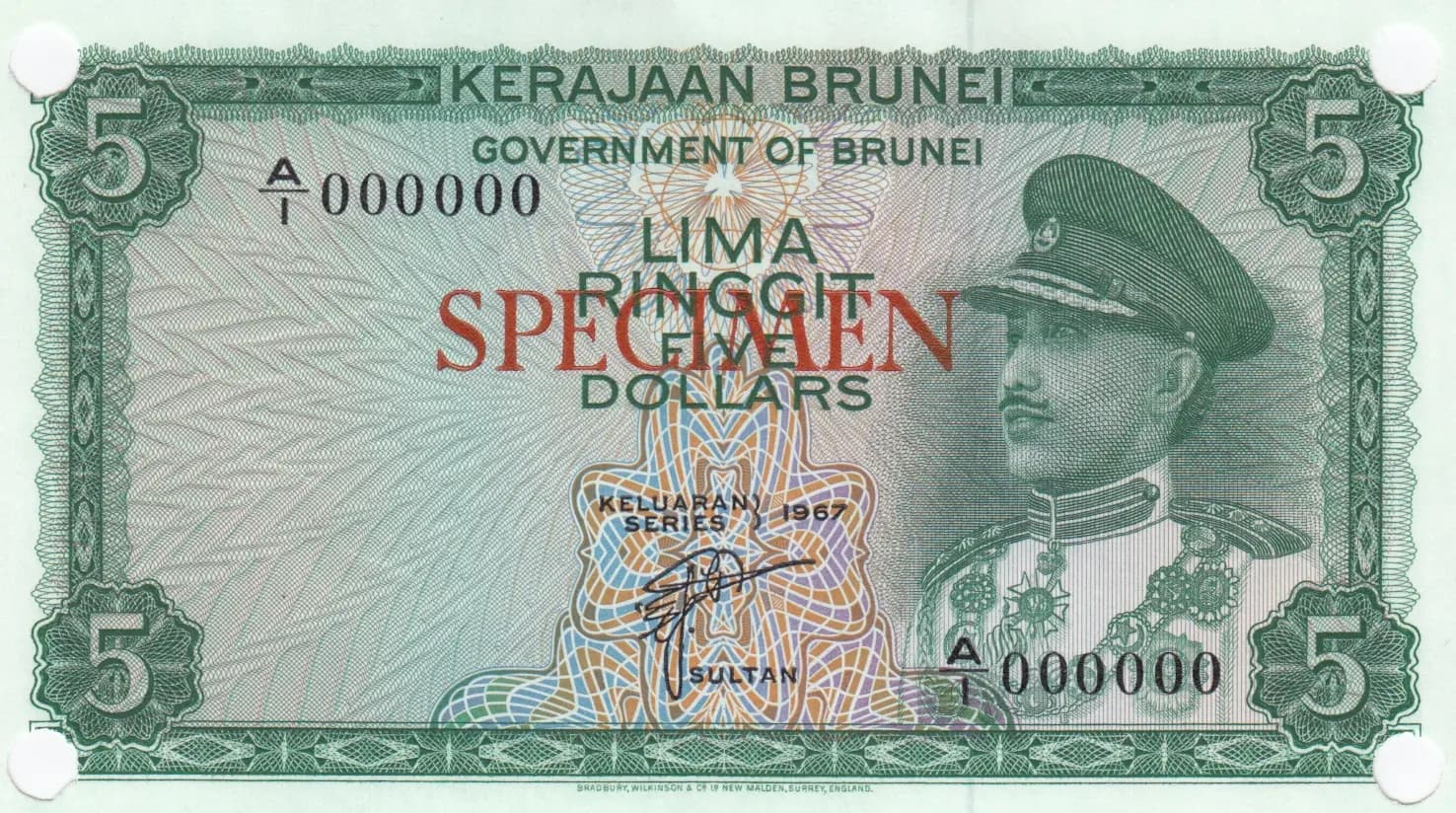
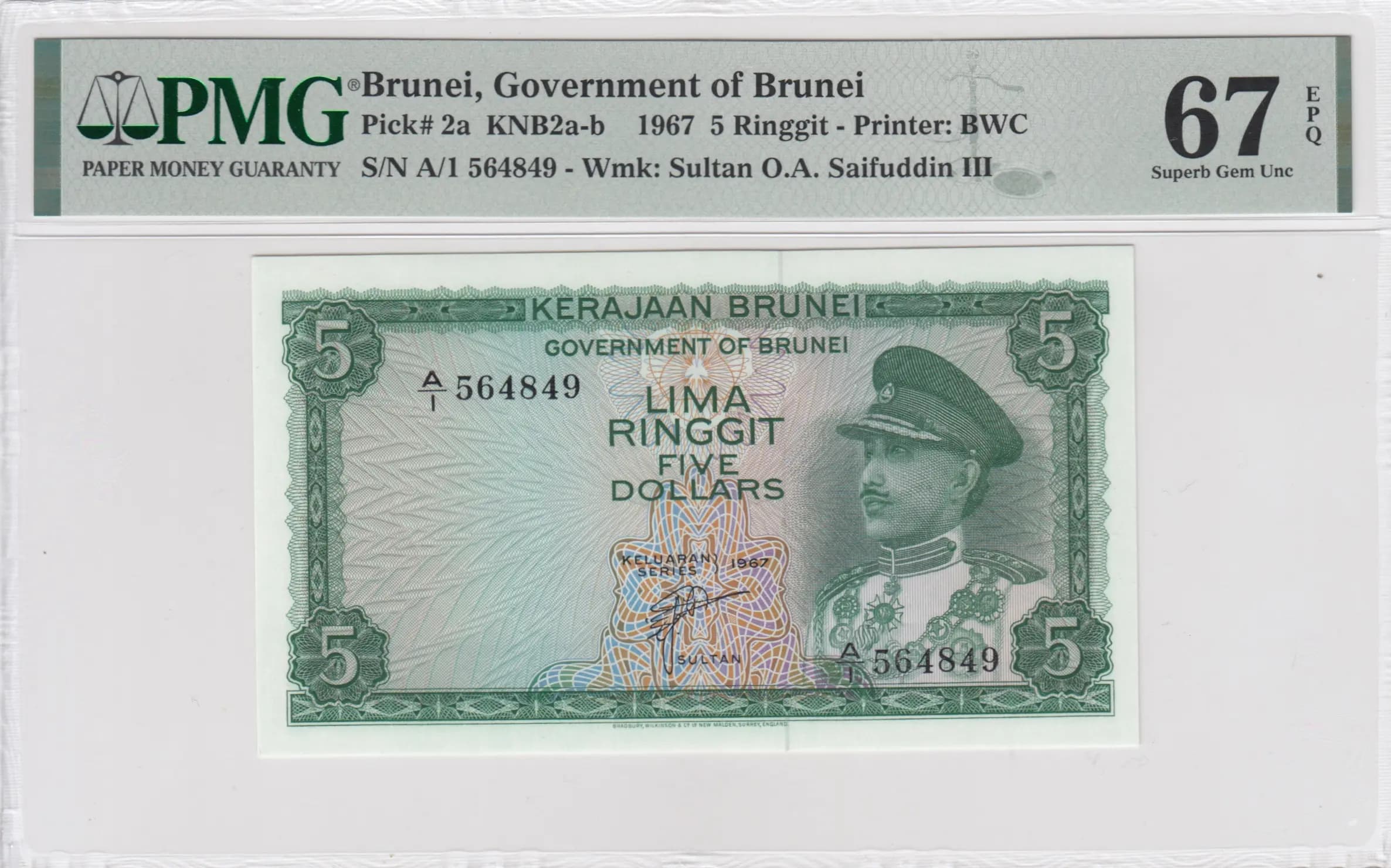
The obverse features a formal three-quarter portrait of Sultan Omar Ali Saifuddin III positioned at right, depicted in full military uniform with decorative medals and insignia, wearing a military cap—the same imagery employed as the note's watermark for security purposes. The central design showcases an ornate decorative medallion incorporating crescent moon and star Islamic imagery, flanked by elaborate guilloche patterns and corner rosette elements characteristic of high-security banknote design. The reverse depicts the Sultan Omar Ali Saifuddin Mosque (also known as the Jame' Asr Hassanil Bolkiah), a prominent Islamic architectural landmark in Bandar Seri Begawan, rendered in fine detail with its central dome and multiple minarets set against a cloudy sky. The composition is framed by geometric Islamic-pattern borders and corner rosettes, with the national emblem positioned in the lower right.
FRONT: 'KERAJAAN BRUNEI' (Malay: Government of Brunei) / 'GOVERNMENT OF BRUNEI' (English: Government of Brunei) / 'LIMA PULOH' (Malay: Fifty) / 'RINGGIT' (Malay: Currency unit) / 'SPECIMEN' (English: Specimen designation) / '50' (Numerical denomination) / '000000' (Specimen serial number area). BACK: '50' (Numerical denomination) / 'GOVERNMENT OF BRUNEI' (English: Government of Brunei) / 'SPECIMEN' (English: Specimen designation) / 'كراچ برونی' (Arabic/Jawi script: Kerajaan Brunei, Government of Brunei) / '50' (Numerical denomination, repeated).
Intaglio engraving and letterpress printing, executed by Bradbury Wilkinson & Co. (BWC), the renowned British currency security printer headquartered in New Malden. The visual evidence of intricate guilloche patterns, fine line work creating dramatic architectural detail, and the precision of the portrait engraving are all hallmarks of intaglio production methods. The specimen note status, indicated by overprinting, confirms this as a non-circulating demonstration of the printing process.
This note is cataloged as Pick P-4s, the specimen variant of the 50 Ringgit. The Pick catalog recognizes three variants for this base denomination: P-4 (standard circulation), P-4cts (a variant, likely with security features or printing differences), and P-4s (specimen). All three variants were printed by Bradbury Wilkinson & Co. (BWC). The specimen designation ('SPECIMEN' overprinted on both obverse and reverse) and the serial number area showing '000000' (typical of specimen production) distinguish this from circulation notes. No signature varieties or date variations are apparent from the visual analysis, as specimen notes typically employ standardized serial number treatments.