100 ringgit 1967 specimen
Market Prices
About This Note
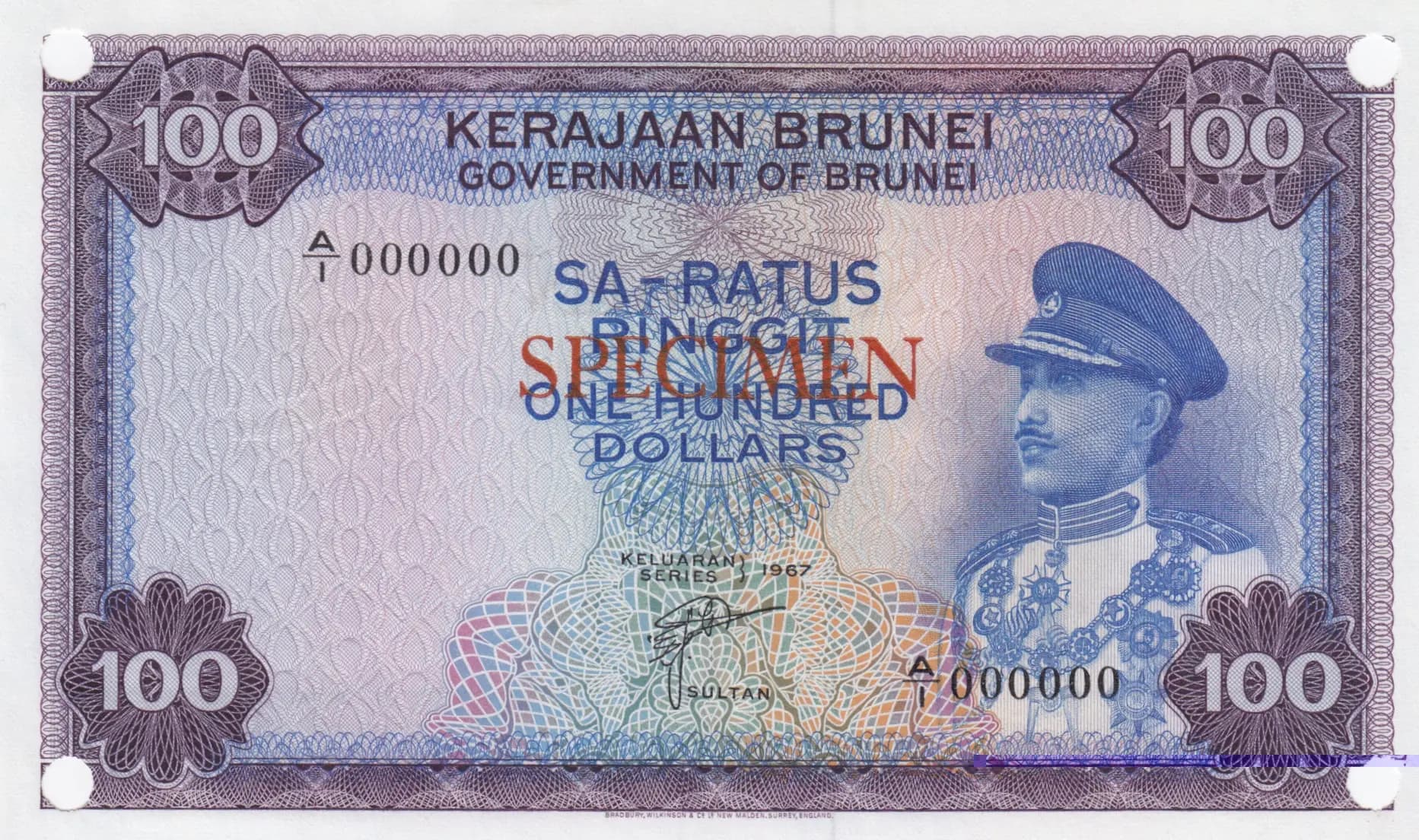
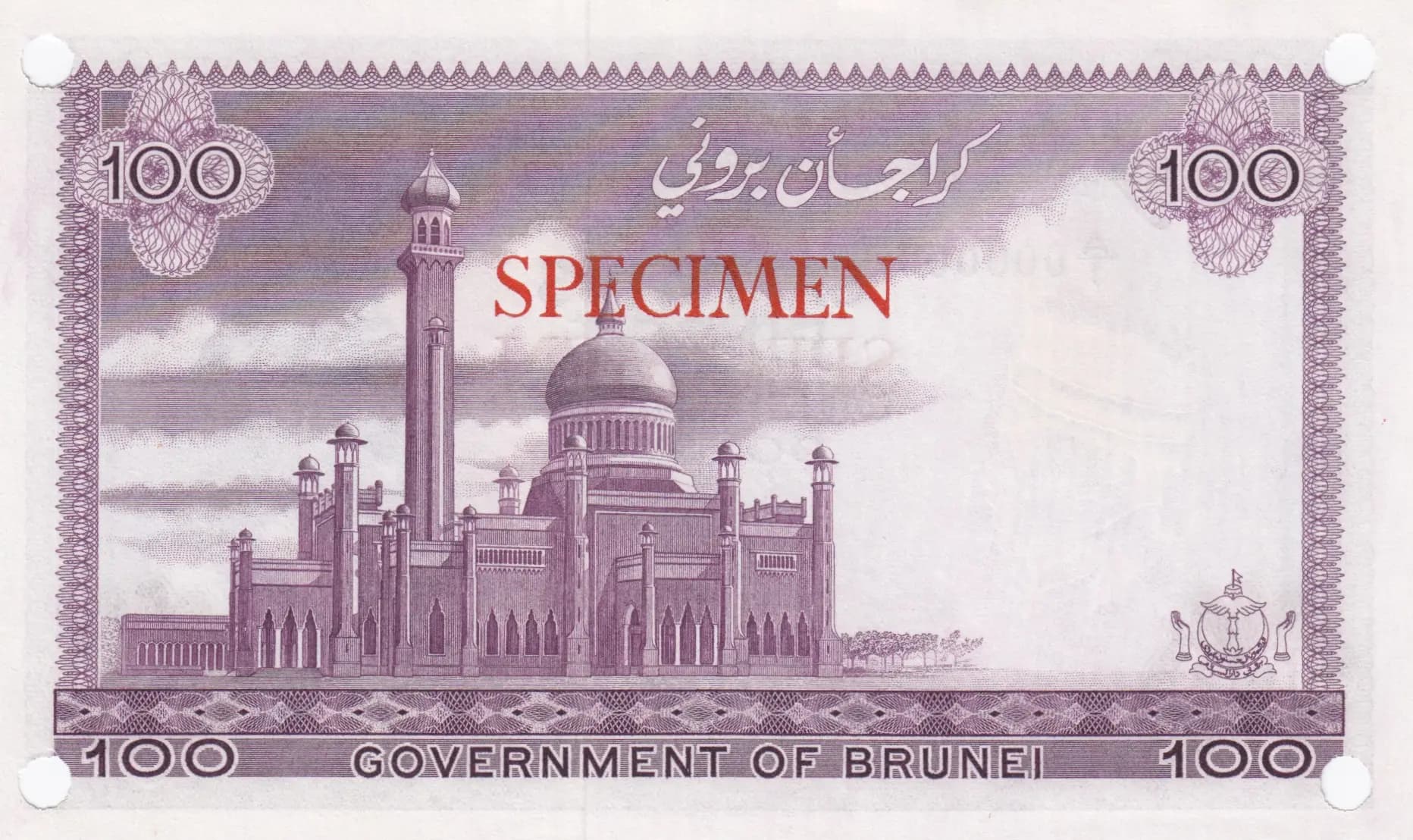
This is a Brunei 100 Ringgit specimen banknote from 1967, graded UNC and issued by the Government of Brunei (Kerajaan Brunei). The note features an elegant portrait of Sultan Omar Ali Saifuddin III in military dress uniform on the obverse, with the iconic Sultan Omar Ali Saifuddin Mosque depicted on the reverse in fine engraved detail. As a specimen note with archival mounting tabs visible in all four corners, this represents an important early example of Brunei's post-independence currency design, preserved in pristine uncirculated condition with crisp printing and no evidence of circulation or handling.
Common. While specimen notes are generally held in higher regard by collectors than circulated examples, the eBay price data provided shows this note trading at widely variable prices ($1.99 to $375.00 USD), with most UNC listings clustered in the $20–$195 range, indicating ready market availability. Specimen notes from major security printers like Bradbury Wilkinson were typically produced in modest quantities for reference and archival purposes, but this 1967 Brunei 100 Ringgit is not documented as a low-print-run rarity. The availability of multiple sales listings at accessible price points confirms this is a common specimen variant rather than a scarce or rare issue.
This 1967 specimen note was issued during a pivotal period for Brunei, following the country's transition toward greater autonomy within the British Commonwealth. The obverse features Sultan Omar Ali Saifuddin III, who reigned during this transformative era and appears both as a portrait and as the watermark figure. The reverse showcases the Sultan Omar Ali Saifuddin Mosque in Bandar Seri Begawan, a symbol of Brunei's Islamic heritage and national identity, reflecting the country's values during this formative period of its modern monetary system.
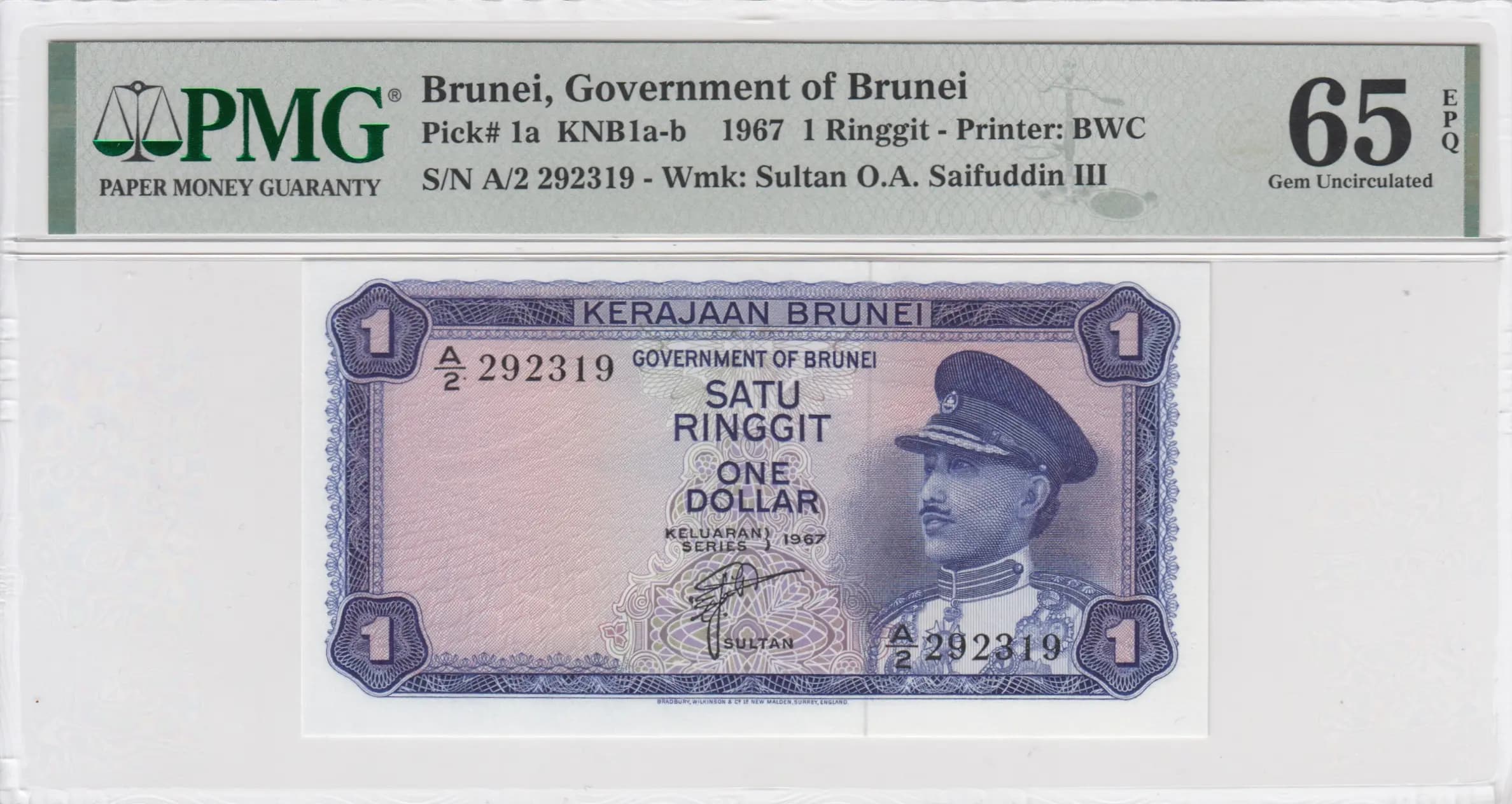
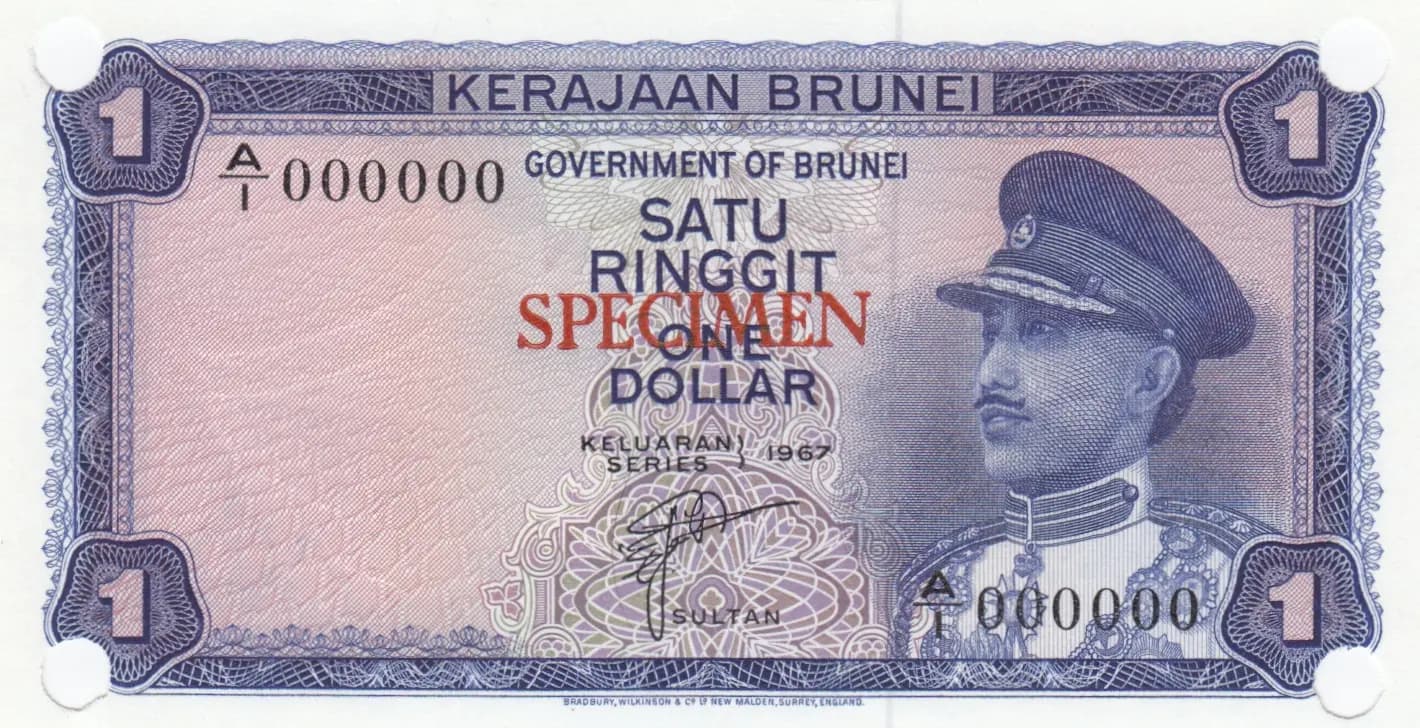
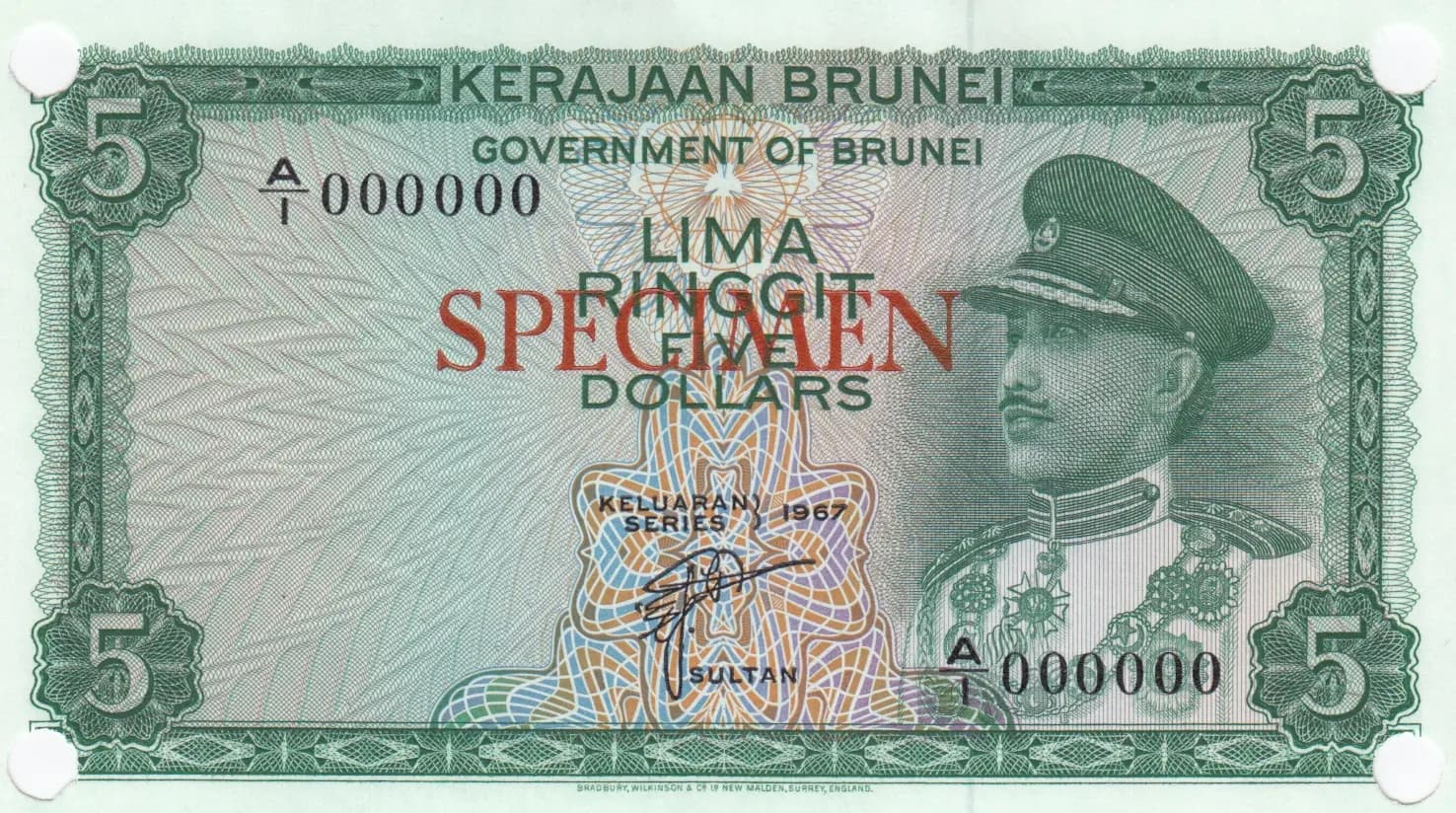
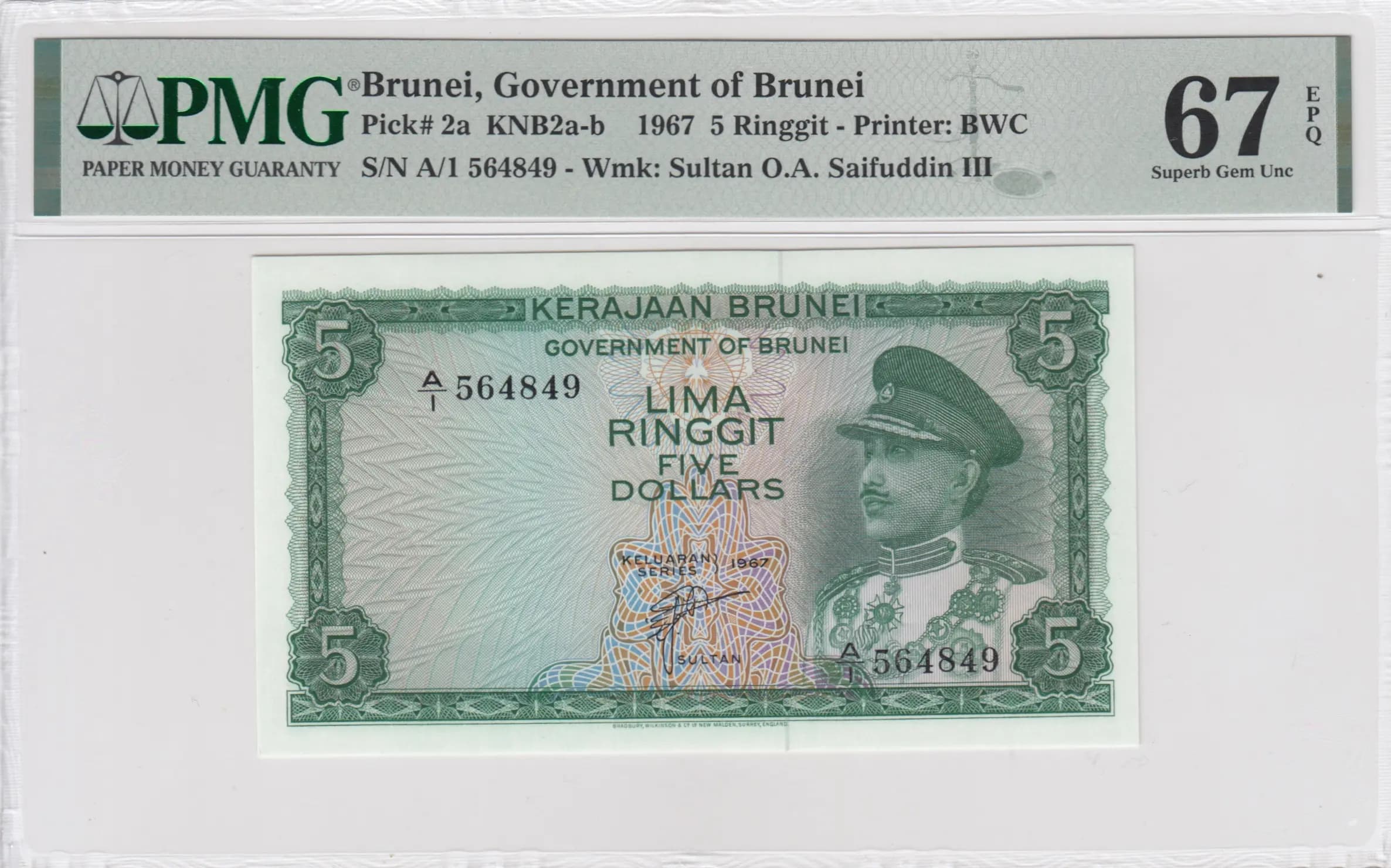
The obverse presents a distinguished three-quarter profile portrait of Sultan Omar Ali Saifuddin III positioned at right, depicted in formal military dress uniform with a peaked cap, rendered in fine engraving typical of high-security banknote production. The left side features elaborate decorative geometric patterns and floral botanical motifs arranged symmetrically. The center contains ornamental designs with the denomination prominently displayed. All four corners feature floral medallion ornaments. The reverse depicts the Sultan Omar Ali Saifuddin Mosque, the primary landmark of Bandar Seri Begawan, rendered in architectural detail with its characteristic central dome, minaret, and flanking domed structures. The mosque illustration demonstrates sophisticated line-work engraving with geometric security patterning in the background. The dominant color scheme employs purple and mauve tones with blue accents on the obverse and purple/mauve with brown on the reverse, creating a cohesive and dignified presentation befitting the high denomination.
FRONT: 'Kerajaan Brunei' (Government of Brunei), 'Government of Brunei', 'Seratus' (One Hundred in Malay), 'One Hundred Dollars', 'A 000000' (specimen serial number), 'Keluaran 1967' (Issue 1967), 'SPECIMEN'. Denomination markings: '100' (Arabic numerals). BACK: 'Kerajaan Brunei' (Government of Brunei in Jawi/Arabic script: كراجان برني), 'Government of Brunei', 'SPECIMEN', '100' (Arabic numerals). Both sides feature bilingual English-Malay inscriptions reflecting Brunei's official languages.
This note was produced using intaglio engraving (steel plate engraving), the security printing method characteristic of Bradbury Wilkinson & Company, Ltd. (BWC), New Malden, the noted printer. The fine line printing, intricate geometric patterns, and detailed architectural rendering of the mosque are hallmarks of intaglio production. Security features include fine-line background patterns, complex border designs, and the sophisticated engraved portraiture, all standard to this printer's high-security banknote production methods of the era.
This note is cataloged as P-5s per Pick (specimen variant of P-5). The PMG population report indicates three documented variants for the base Pick number P-5: the standard P-5, P-5cts (color trial specimen), and P-5s (specimen). This example is the P-5s variant. The 'A 000000' serial number marking is consistent with specimen issue practice (non-circulating reference copies). No individual signature varieties are evident in the visual analysis of this specimen note, as such notes typically feature standard printing without unique signatures. The 'SPECIMEN' overprint on both obverse and reverse, along with the archival mounting tabs visible in all four corners, confirm this as a specimen issue rather than a regular circulation note.