1 ringgit 1976
Market Prices
20 salesAbout This Note
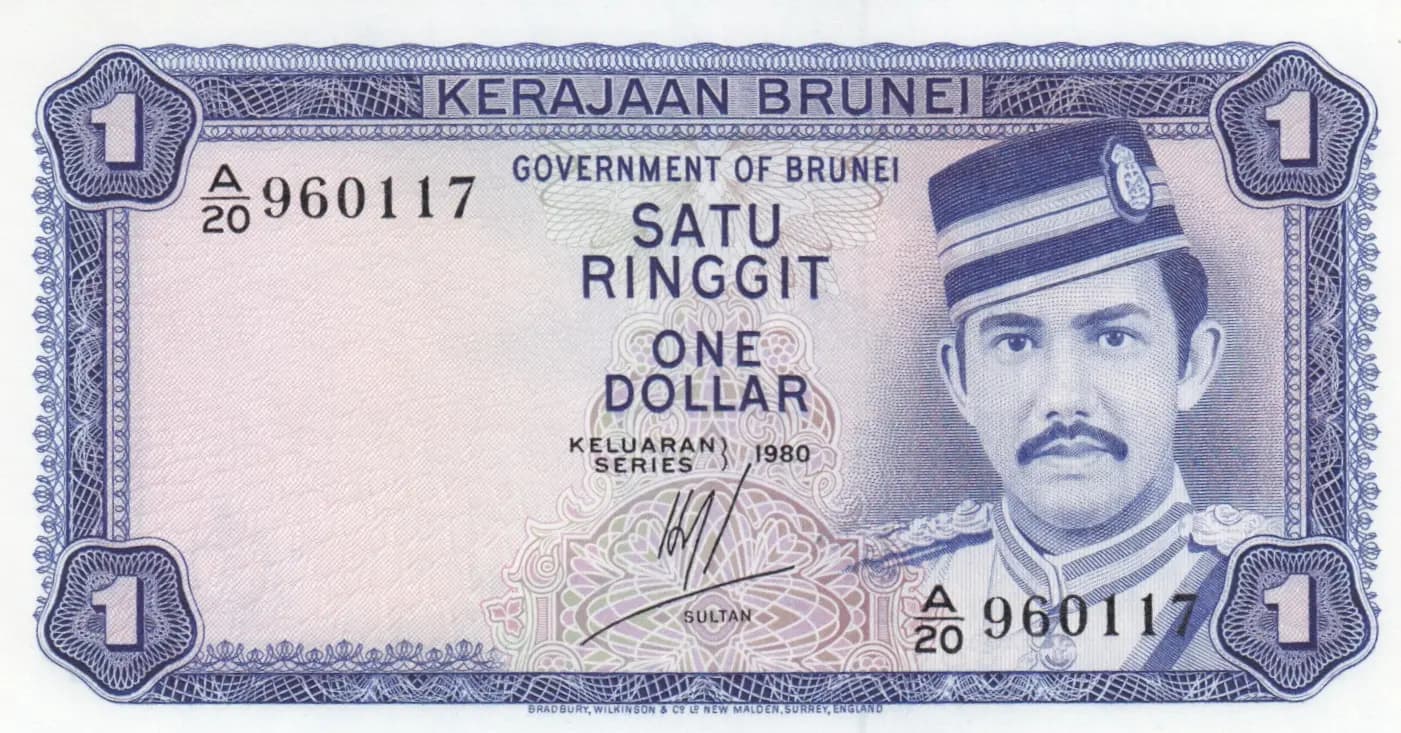
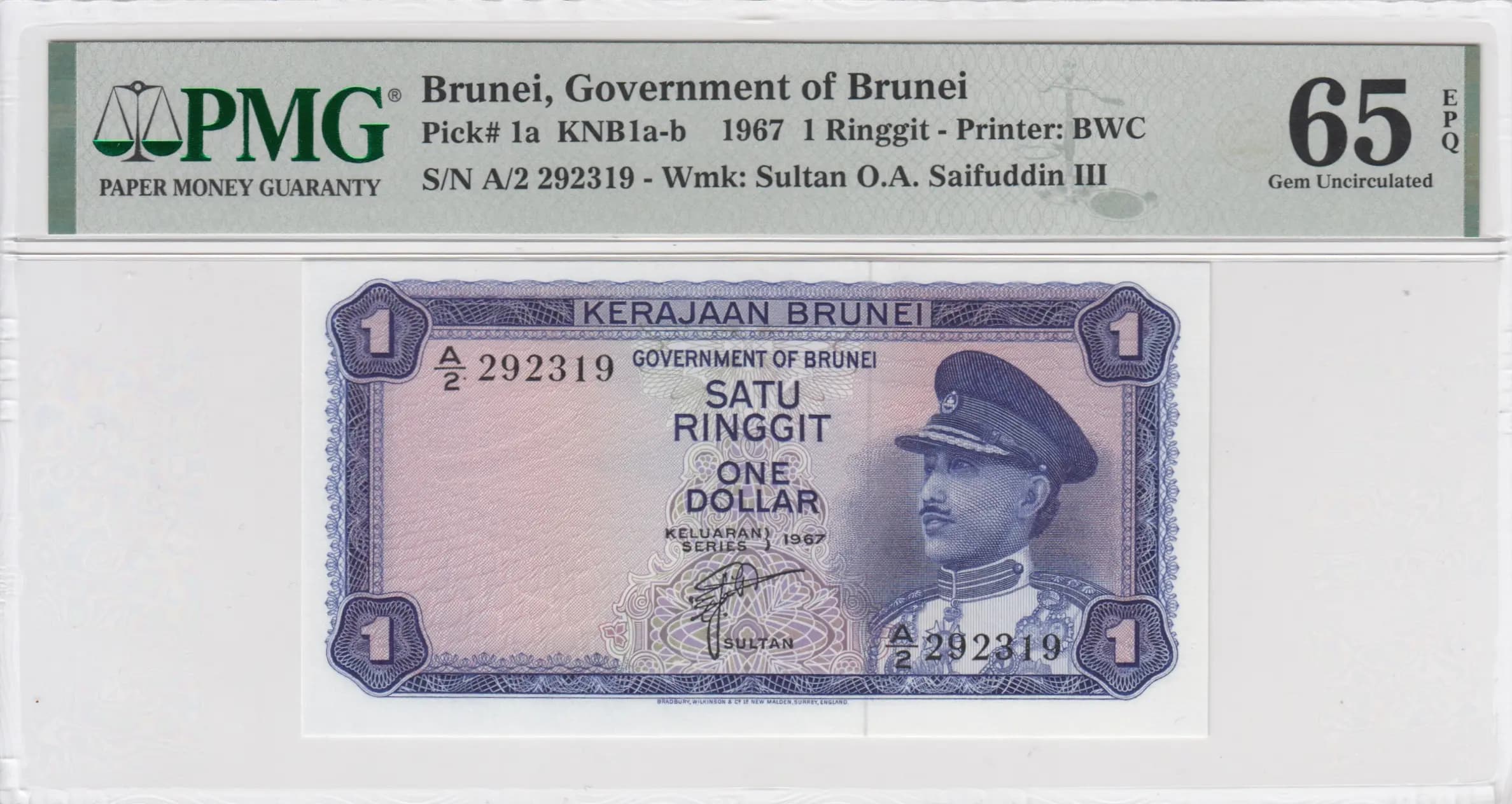
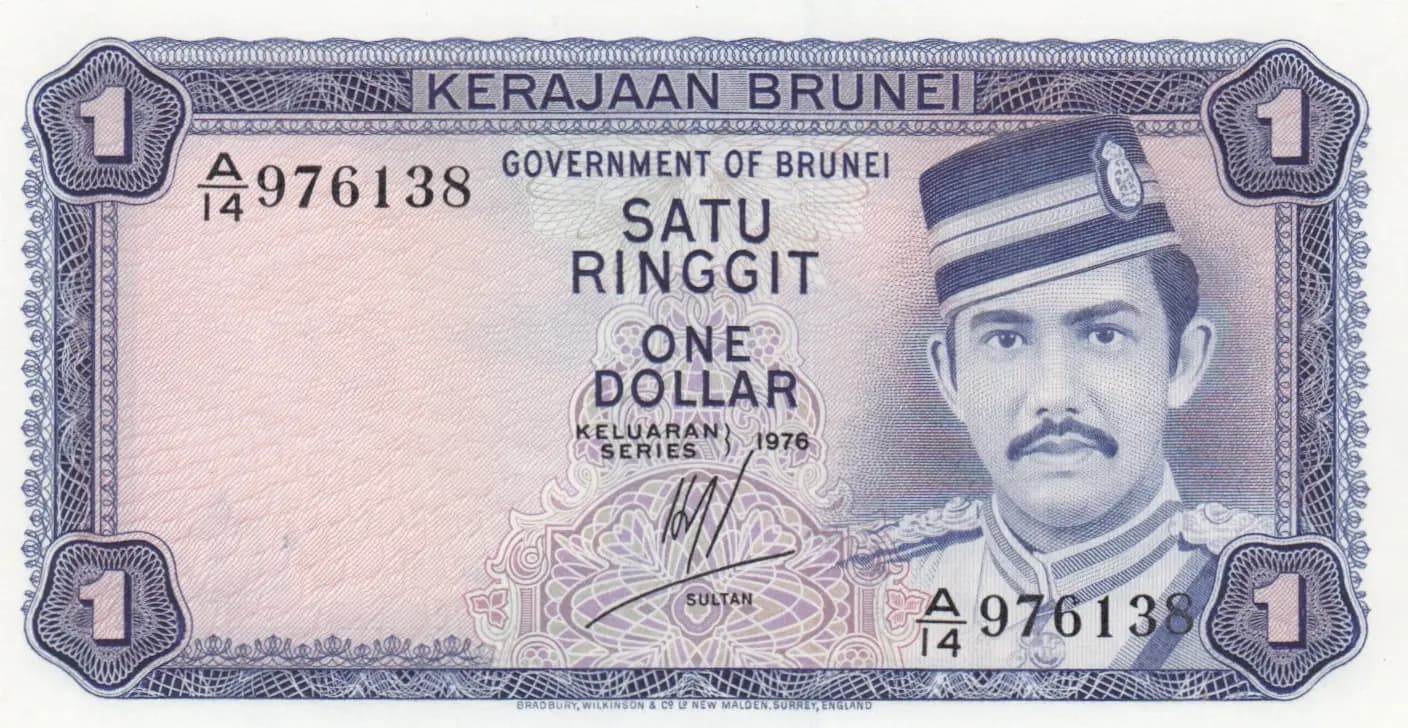
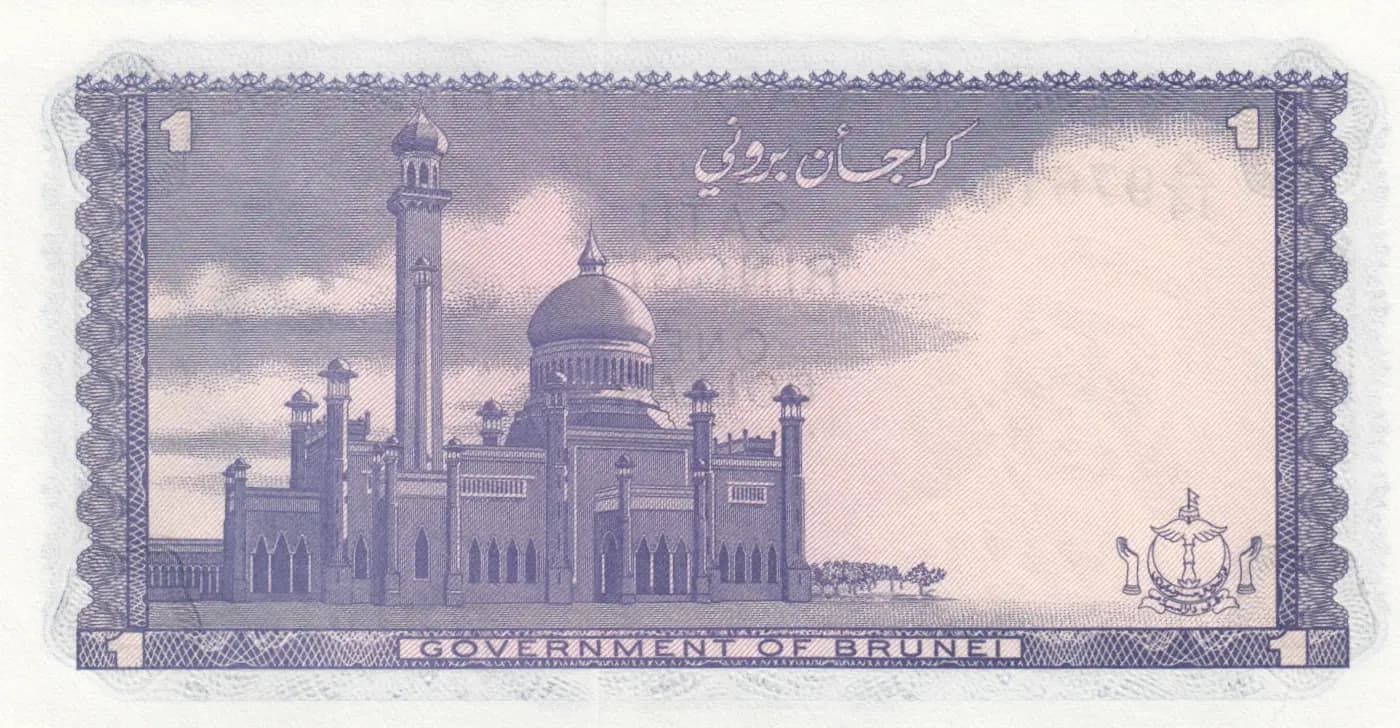
This is an uncirculated 1976 Brunei 1 Ringgit note (Pick P-6a) featuring Sultan Hassanal Bolkiah I in traditional military dress and songkok headwear on the obverse, with the iconic Sultan Omar Ali Saifuddin Mosque rendered in fine engraved detail on the reverse. The note exhibits pristine condition with sharp, crisp printing throughout, clean surfaces, and vibrant purple/lavender coloration characteristic of this series. As a 1976-dated specimen from the long-running 1972-1988 series printed by Bradbury Wilkinson, this represents a highly sought intermediate-year variant with solid collector appeal.
Common. This note is from the extended 1972-1988 standard circulation series with substantial print runs across multiple years (1972, 1976, 1978 confirmed date variants). eBay market data shows consistent pricing patterns with uncirculated examples regularly selling in the $14-30 range, and lower grades (VF-AUNC) trading for $1.29-$6.00. The PMG population report lists six cataloged variants (P-6a through P-6d plus overprint and specimen versions), indicating broad accessibility. No short print runs, recalls, or scarcity factors are associated with this Pick number.
This note was issued during Brunei's early post-independence period, following the country's transition to full sovereignty in 1984, though the series design dates to 1972 when Brunei was still a British protectorate. The obverse portrait honors Sultan Hassanal Bolkiah I, who ascended to the throne in 1967 and oversaw Brunei's political modernization. The reverse depicts the Sultan Omar Ali Saifuddin Mosque in Bandar Seri Begawan, an architectural symbol of Brunei's Islamic heritage and cultural identity, reinforcing the nation's religious and civic values during this formative era.
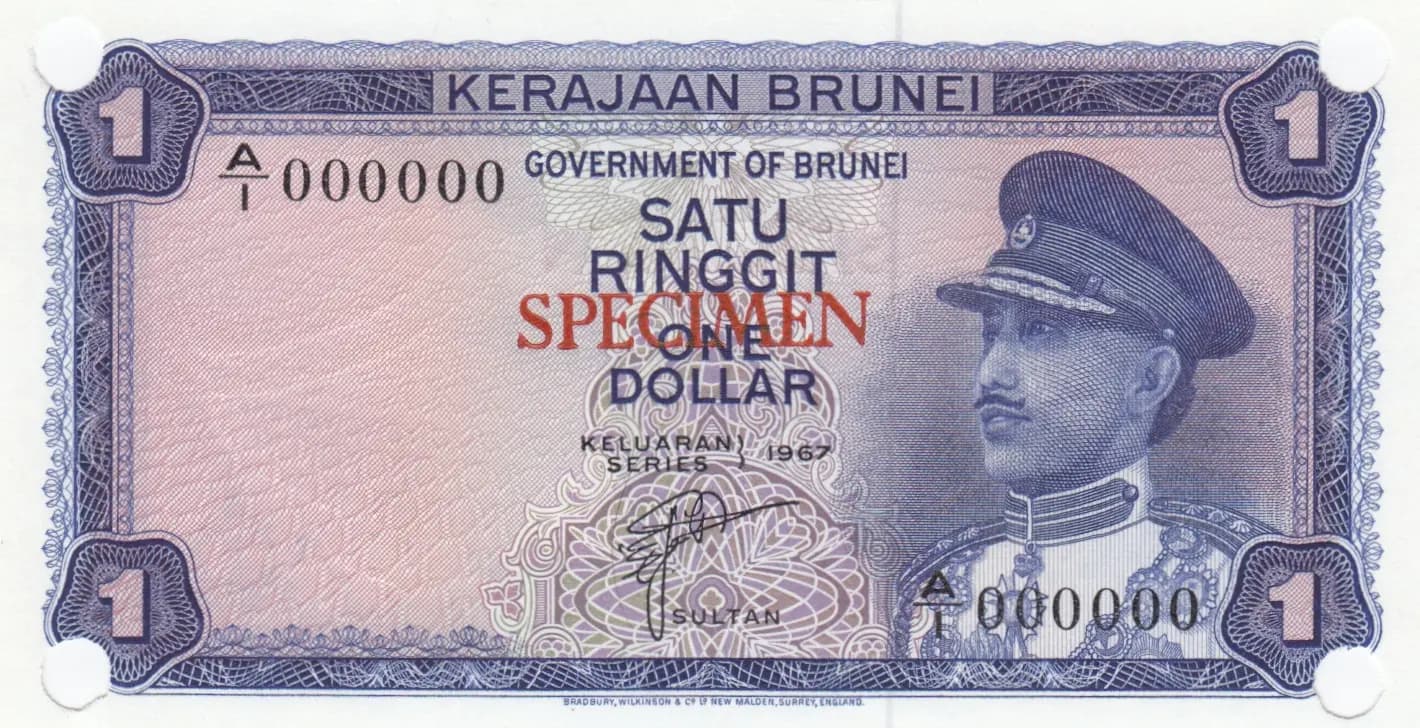
The obverse features a right-facing portrait of Sultan Hassanal Bolkiah I (the reigning Sultan of Brunei) rendered in fine engraving, wearing his characteristic military uniform with a formal striped songkok (traditional Brunei royal headwear). The portrait serves as both the primary vignette and the watermark. Decorative corner medallions frame all four corners with the numeral '1'. Bilateral text identifies the issuer and denomination in English and Malay, emphasizing Brunei's dual cultural identity. The reverse showcases an architecturally accurate engraved rendering of the Sultan Omar Ali Saifuddin Mosque (also known as the Jame' Asr Hassanil Bolkiah Mosque), the nation's principal Islamic place of worship located in Bandar Seri Begawan, depicted with its distinctive central dome, minarets, and symmetrical gate structures. The Brunei national coat of arms appears at the lower right of the reverse.
Front side: 'KERAJAAN BRUNEI' (Brunei Kingdom) and 'GOVERNMENT OF BRUNEI' frame the denomination bilingual text 'SATU RINGGIT' / 'ONE DOLLAR' with the issue date '1976' and series designation 'KELUARAN SERIES' (Issue Series). The portrait cartouche reads 'SULTAN'. Serial number 'A14 9761138' appears twice. Printer credit: 'BRADBURY, WILKINSON & CO LTD NEW MALDEN, SURREY, ENGLAND'. Reverse side: Arabic/Jawi script 'كراجاان برونيل' (Kerajaan Brunei / Brunei Kingdom) and 'GOVERNMENT OF BRUNEI' with denomination numeral '1' in corner medallions.
Intaglio engraving (recess printing), the hallmark security printing method used by Bradbury Wilkinson & Co Ltd, a premier London-based banknote security printer. The fine line engraving throughout both sides, evident in the intricate portraiture, architectural detail, ornamental borders, and decorative patterns, demonstrates classic high-security banknote production. Serial numbers are applied in two locations on the obverse. The color scheme—dominant purple/lavender with blue underprinting—was achieved through multi-color intaglio registration, typical of Commonwealth-era banknote design.
This specimen is cataloged as Pick P-6a, printed by Bradbury Wilkinson & Co Ltd (BWC). The 1976 date confirms this as an intermediate-year printing within the long series. Serial number 'A14 9761138' with prefix 'A14' is consistent with standard circulation production. Related varieties cataloged by PMG include P-6b, P-6c, P-6cts (color trial/specimen), P-6d, and P-6s (specimen), though no specific distinguishing characteristics between lettered variants (a-d) are documented in accessible references. The 1976 date variant itself represents a middle production year between the 1972 inaugural issue and later 1978 printings, making it neither the scarce first-year nor the later common later-year variant.