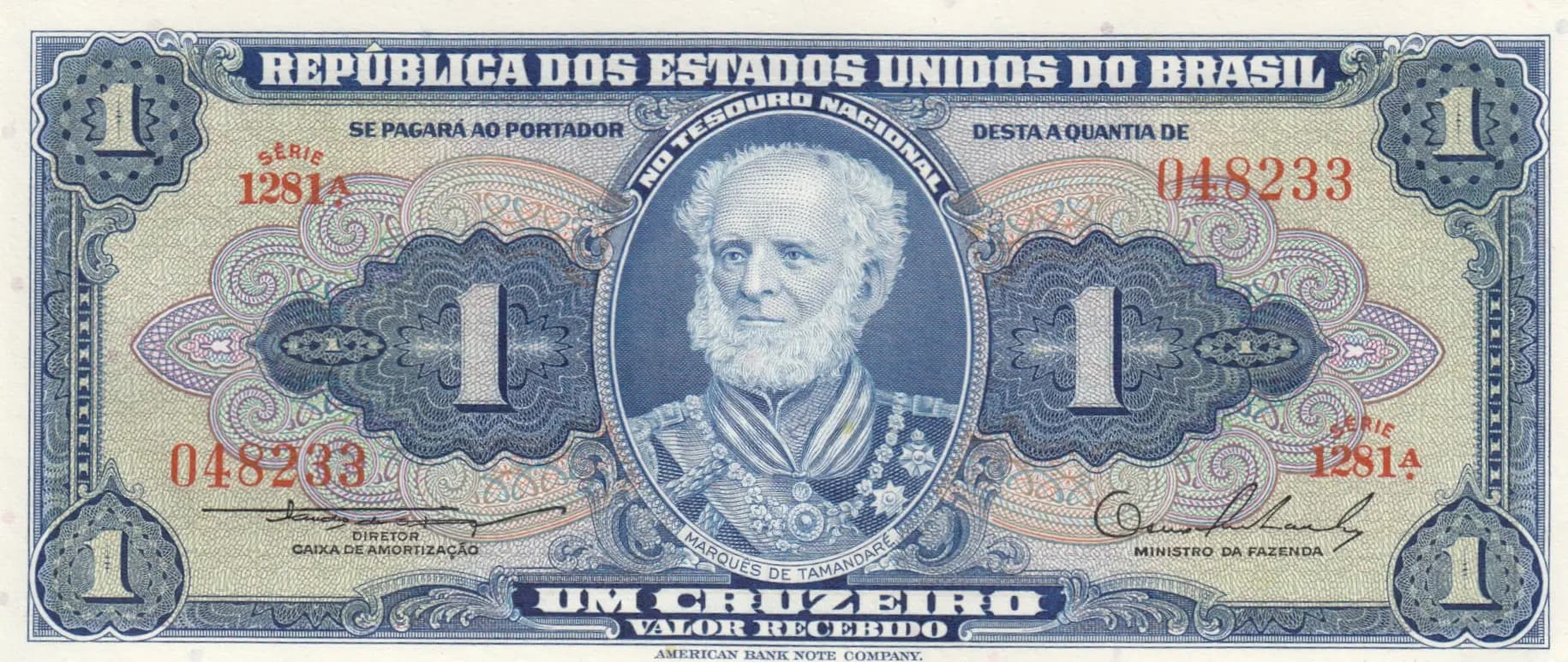
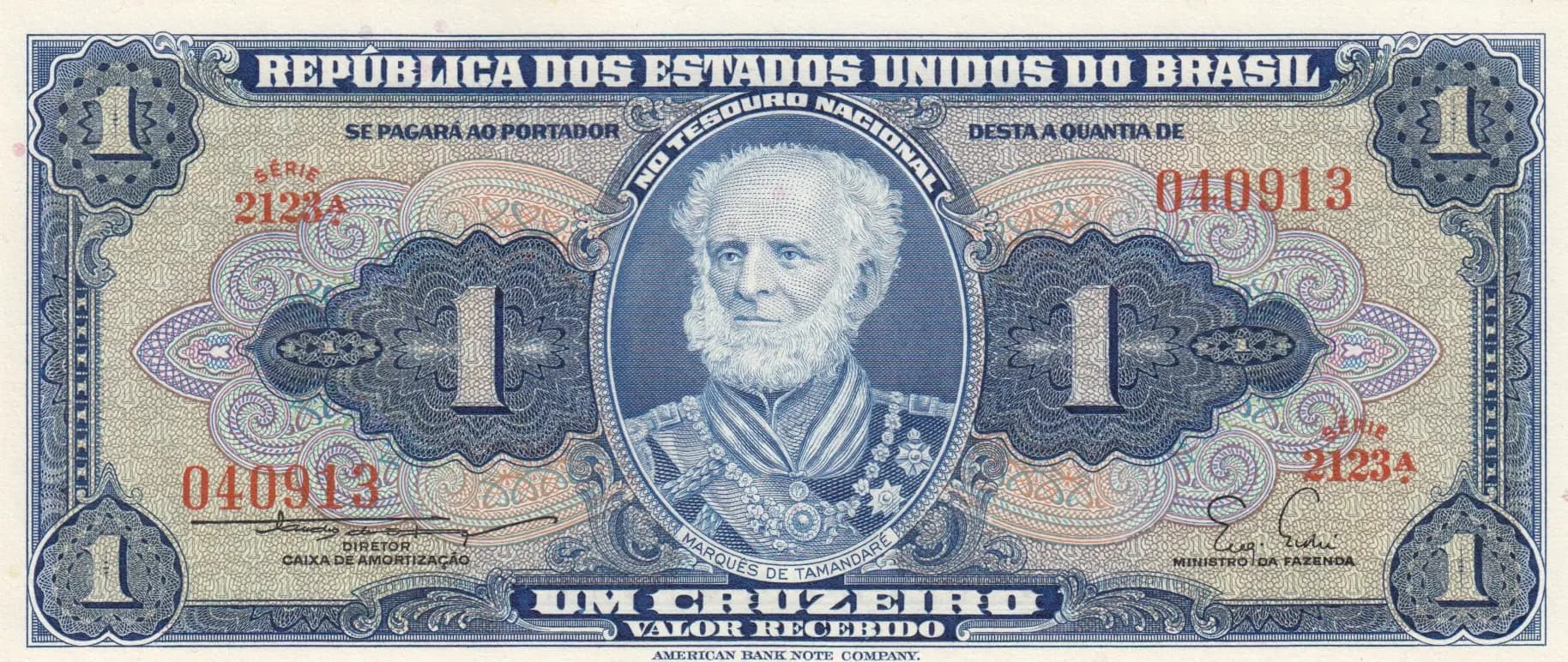
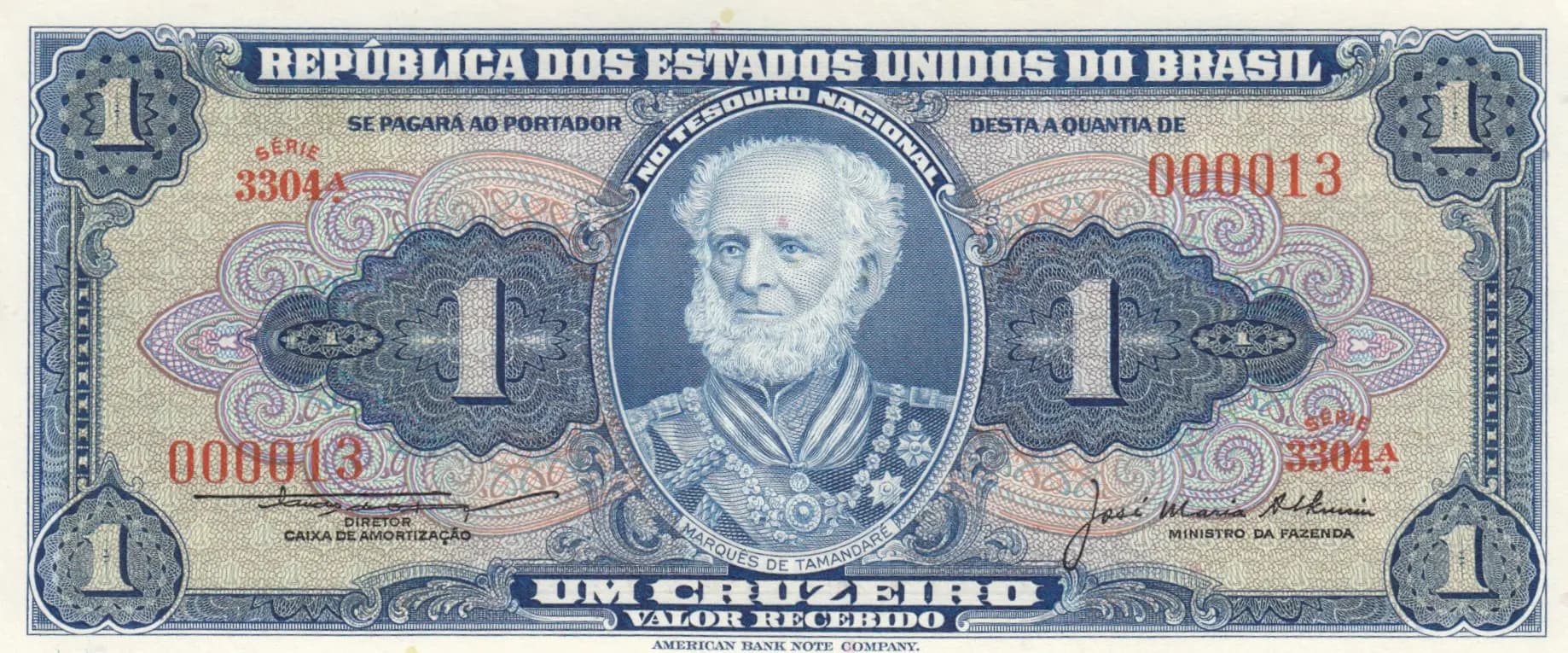
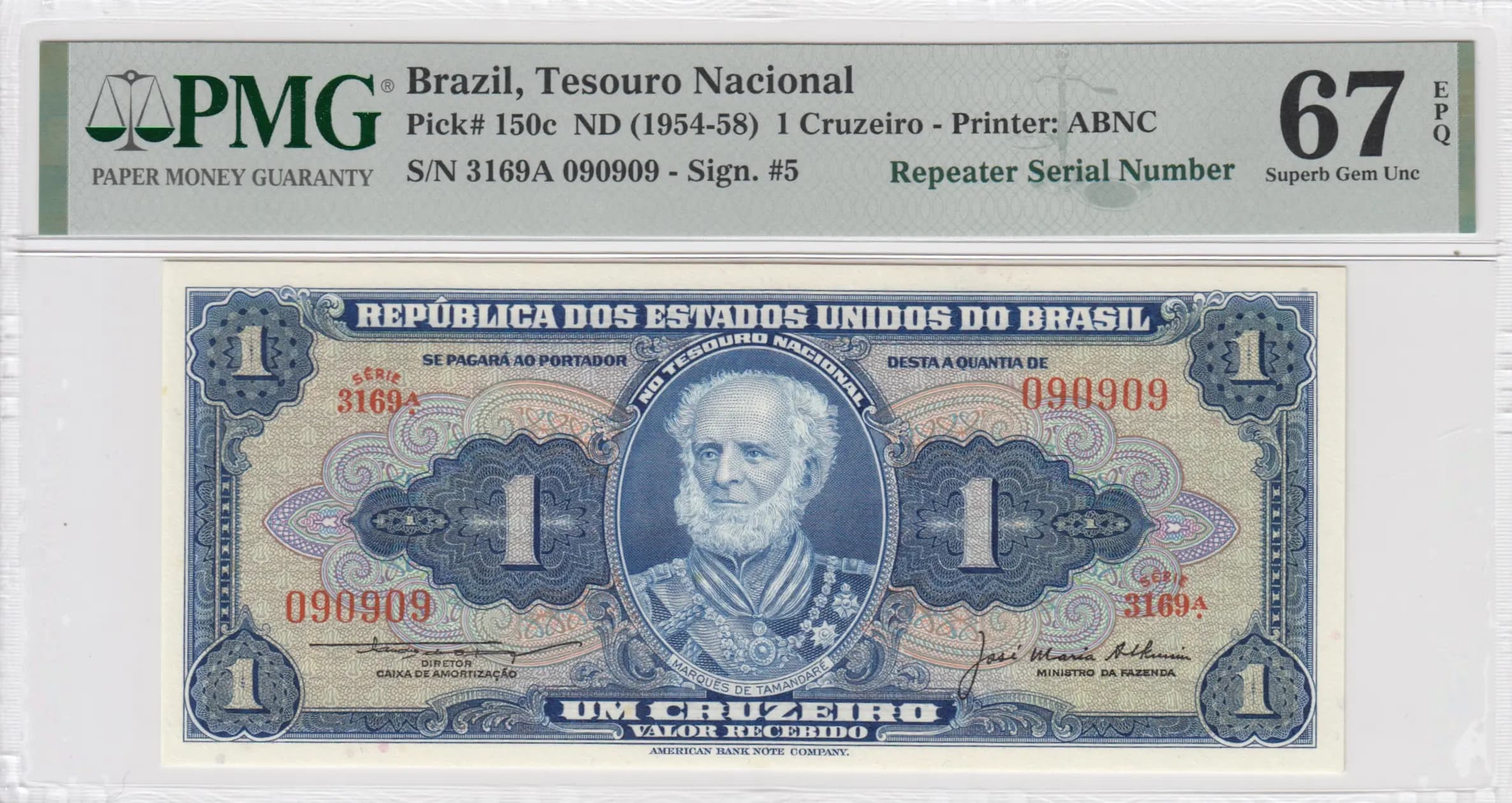
1 cruzeiro 1954
Market Prices
33 salesAbout This Note
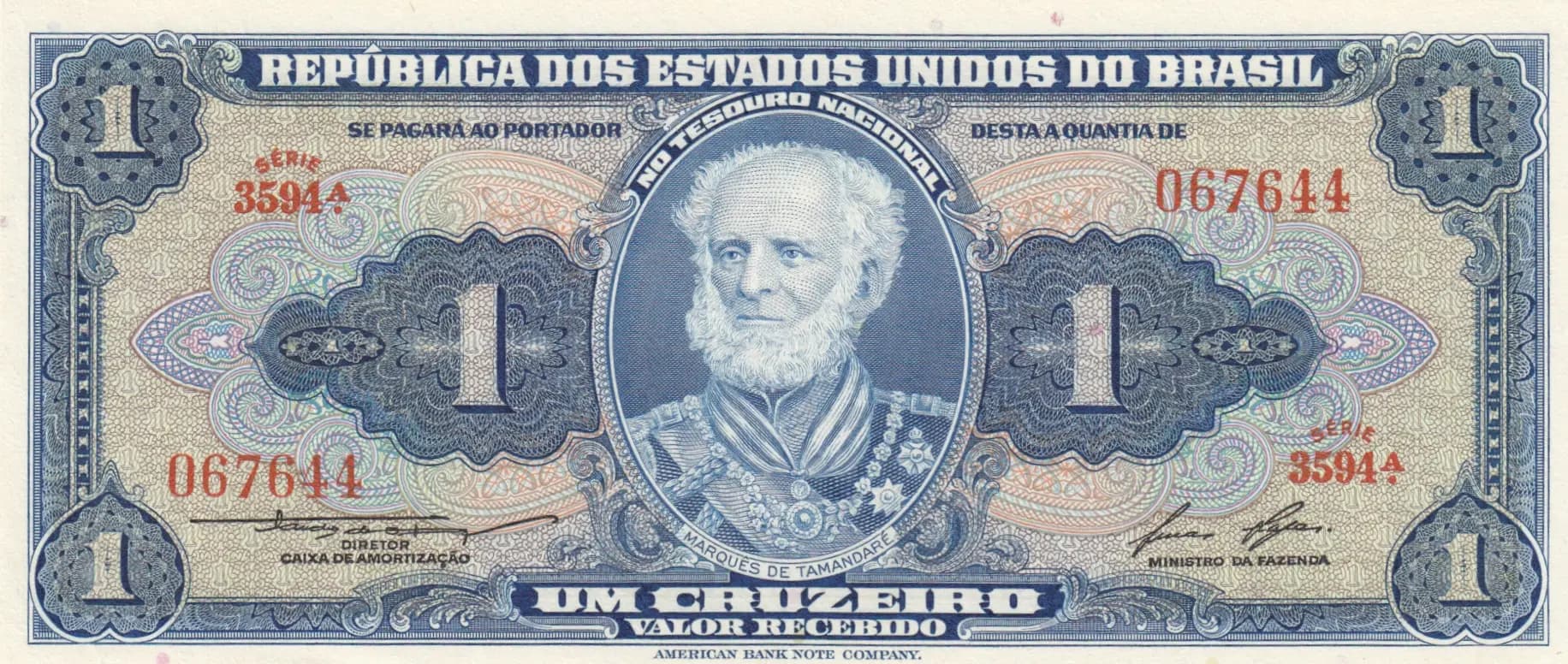
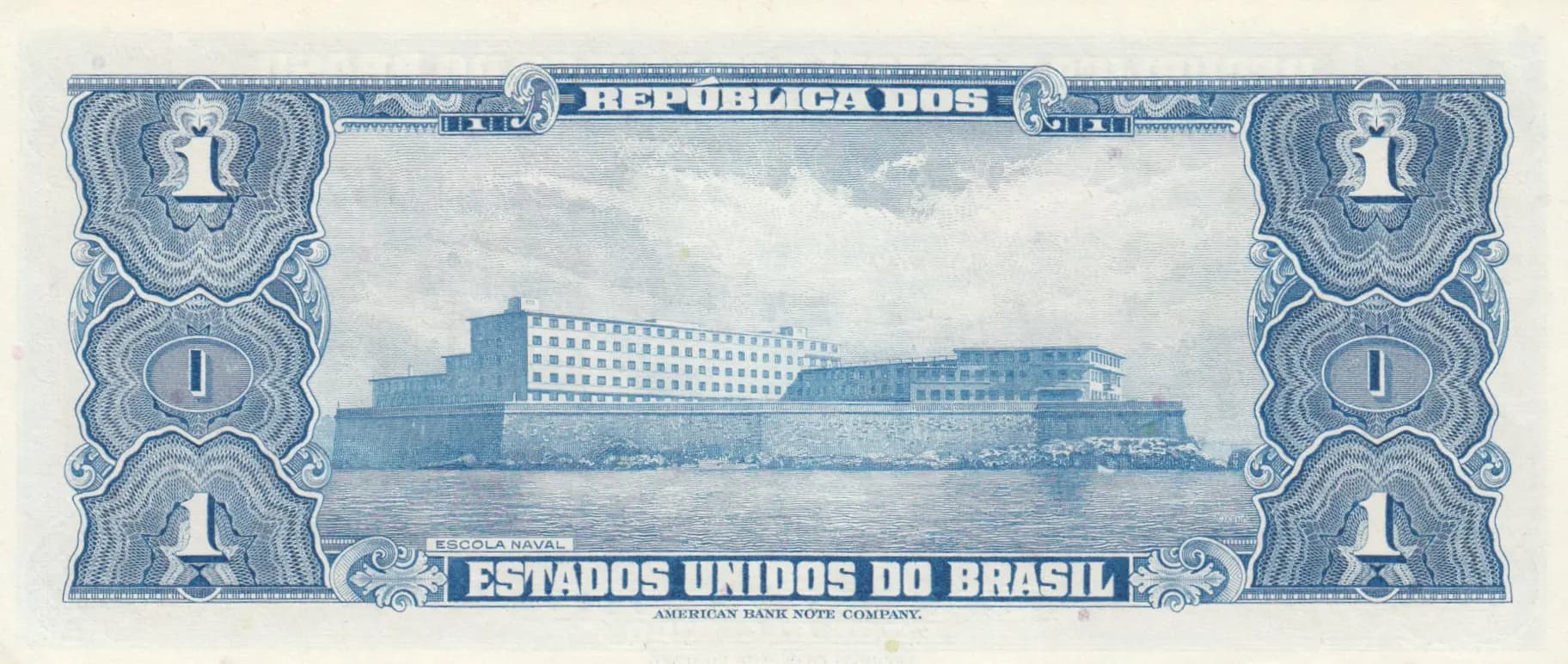
This 1954 Brazilian 1 Cruzeiro note (Pick P-150d) presents in uncirculated condition with crisp paper and vibrant multi-color printing by the American Bank Note Company. The obverse features an impressive central portrait of Marquês de Tamandaré in military dress with medals, surrounded by ornate baroque-style borders in blue and tan, while the reverse displays a detailed engraving of the Naval School in Rio de Janeiro. The note exhibits excellent eye appeal with minimal aging for its era, making it an attractive example of mid-20th century Brazilian currency.
Common. The eBay market data demonstrates consistent availability with numerous sales across multiple condition grades (VG through PMG 66) spanning from 2013 to 2026, with typical realized prices ranging from $0.54 to $3.25 for circulated examples and $1.02-$2.32 for UNC examples. This note was part of a regular currency issue with substantial print runs (series numbers 3451-3690 documented), and its continued availability in the secondary market at modest prices confirms its common status. Even PMG-graded examples command only $15-$23, indicating no numismatic premium.
Issued during Brazil's transition period under the Cruzeiro currency system (1942-1967), this note commemorates Marquês de Tamandaré, a significant naval figure in Brazilian history, reflecting the nation's pride in its maritime heritage. The depiction of the Naval School (Escola Naval) on the reverse reinforces Brazil's military modernization and institutional development during the 1950s. The note was printed by the American Bank Note Company, demonstrating the international standards employed by the Tesouro Nacional (National Treasury) for Brazilian currency production.
The obverse features Joaquim Marques Lisboa (Marquês de Tamandaré), 19th-century Brazilian naval officer and Minister of the Navy, depicted in formal military regalia with decorative insignia and medals, positioned within an ornate oval frame at the center. Large numerals '1' appear in all four corners within elaborate baroque-style medallions. The reverse displays the Escola Naval (Naval School) of Rio de Janeiro, an institutional landmark building situated at the waterfront, rendered in fine engraved detail. Both sides incorporate the Brazilian national coat of arms and feature intricate guilloche patterns and geometric borders as security elements. Red serial numbers provide additional identification, while the note's color scheme emphasizes blue and tan tones typical of American Bank Note Company production standards.
FRONT: 'REPÚBLICA DOS ESTADOS UNIDOS DO BRASIL' (Republic of the United States of Brazil) | 'SE PAGARÁ AO PORTADOR' (Will be paid to bearer) | 'DESTA QUANTIA DE' (Of this quantity of) | 'UM CRUZEIRO' (One Cruzeiro) | 'VALOR RECEBIDO' (Value received) | 'DIRETOR CAIXA DE AMORTIZAÇÃO' (Director, Amortization Fund) | 'MINISTRO DA FAZENDA' (Finance Minister) | 'MARQUÊS DE TAMANDARÉ' (Marquis of Tamandaré) | 'MOT TESOURO NACIONAL' (National Treasury) | 'AMERICAN BANK NOTE COMPANY' | Serial numbers: 35914 / 067644. BACK: 'REPÚBLICA DOS ESTADOS UNIDOS DO BRASIL' (Republic of the United States of Brazil) | 'ESCOLA NAVAL' (Naval School) | 'AMERICAN BANK NOTE COMPANY'.
Intaglio (engraved) printing by American Bank Note Company, New York. The note demonstrates sophisticated multi-color engraving with detailed baroque border patterns, complex geometric guillochés, and fine architectural rendering of the Naval School. Security features include intricate engraved designs throughout, multiple color application in coordinated blue and tan tones, and serial numbering in contrasting red ink applied by letterpress or supplementary printing technique.
Pick P-150d is identified as a variant within the 1 Cruzeiro 1954-1958 series. The note exhibits 2 printed signatures as documented for this variant. Series numbers in the range 3451-3690 are documented for this issue. The ABNC printer attribution and 'VALOR RECEBIDO' designation (indicating 'value received' from the National Treasury) are consistent characteristics of P-150d. No overprints or additional varieties are evident in the observed example; this represents a standard emission of the regular issue type.