5 pounds 1939
Market Prices
7 salesAbout This Note
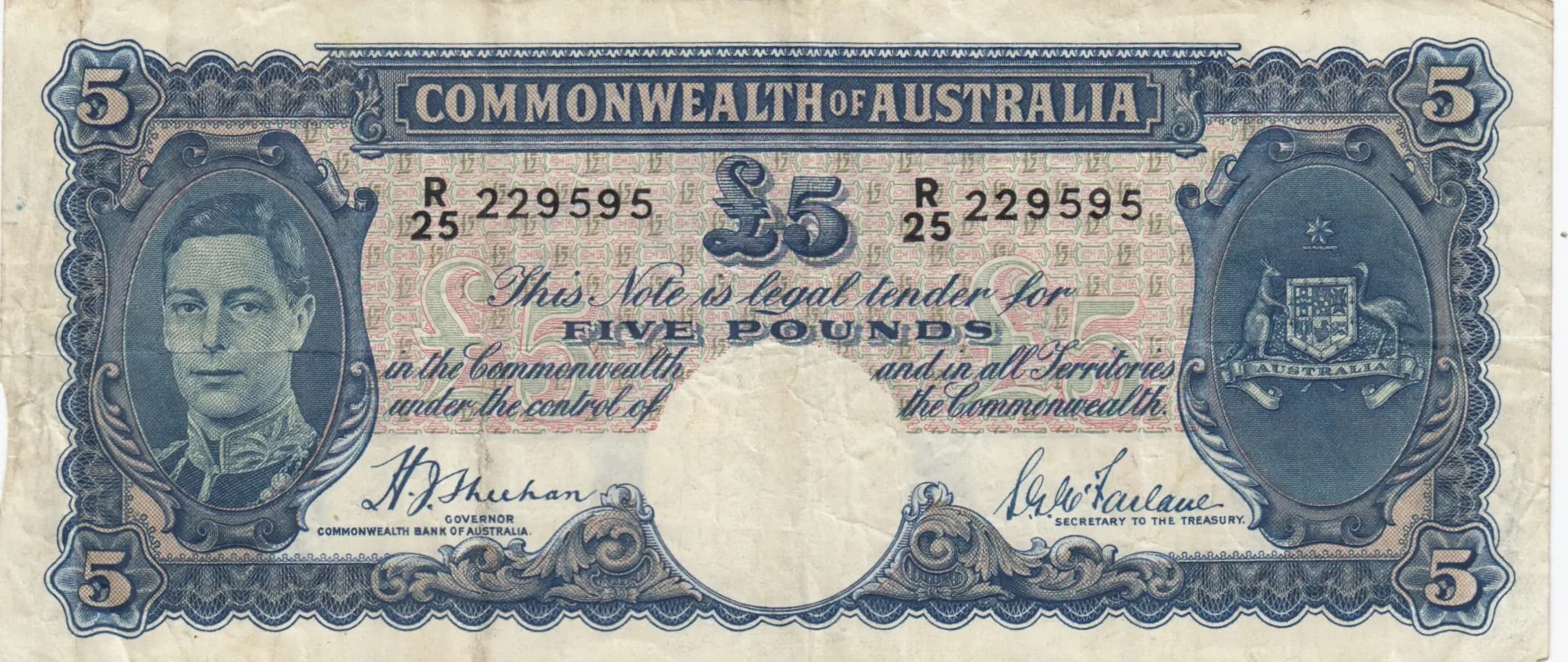
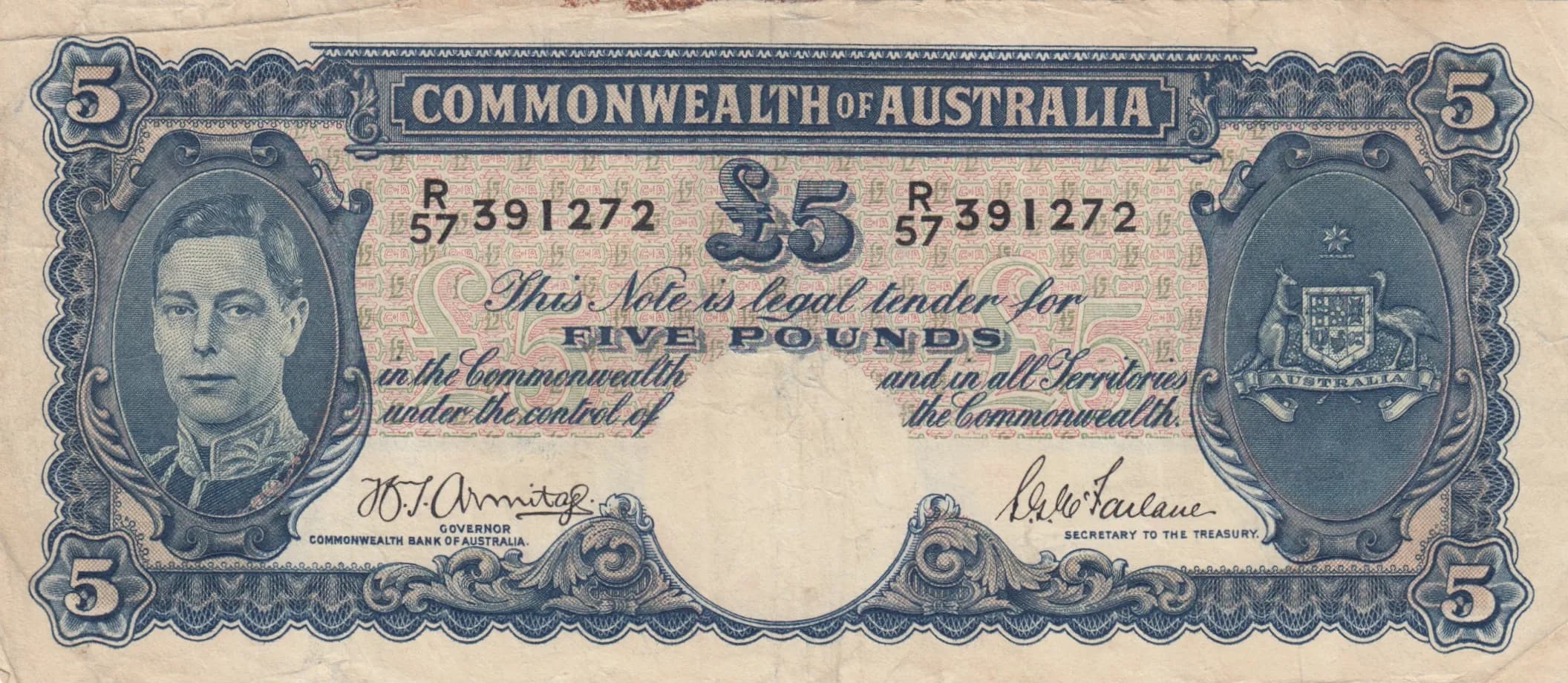
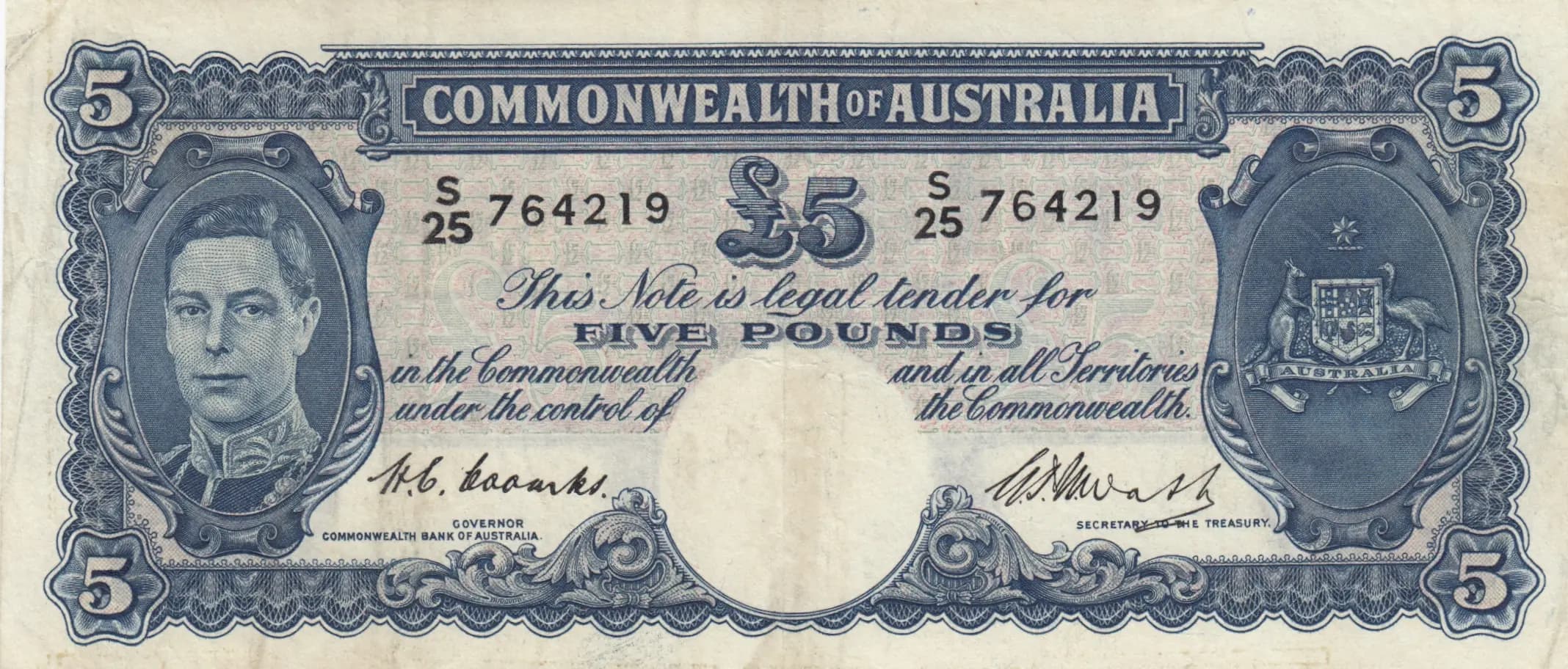
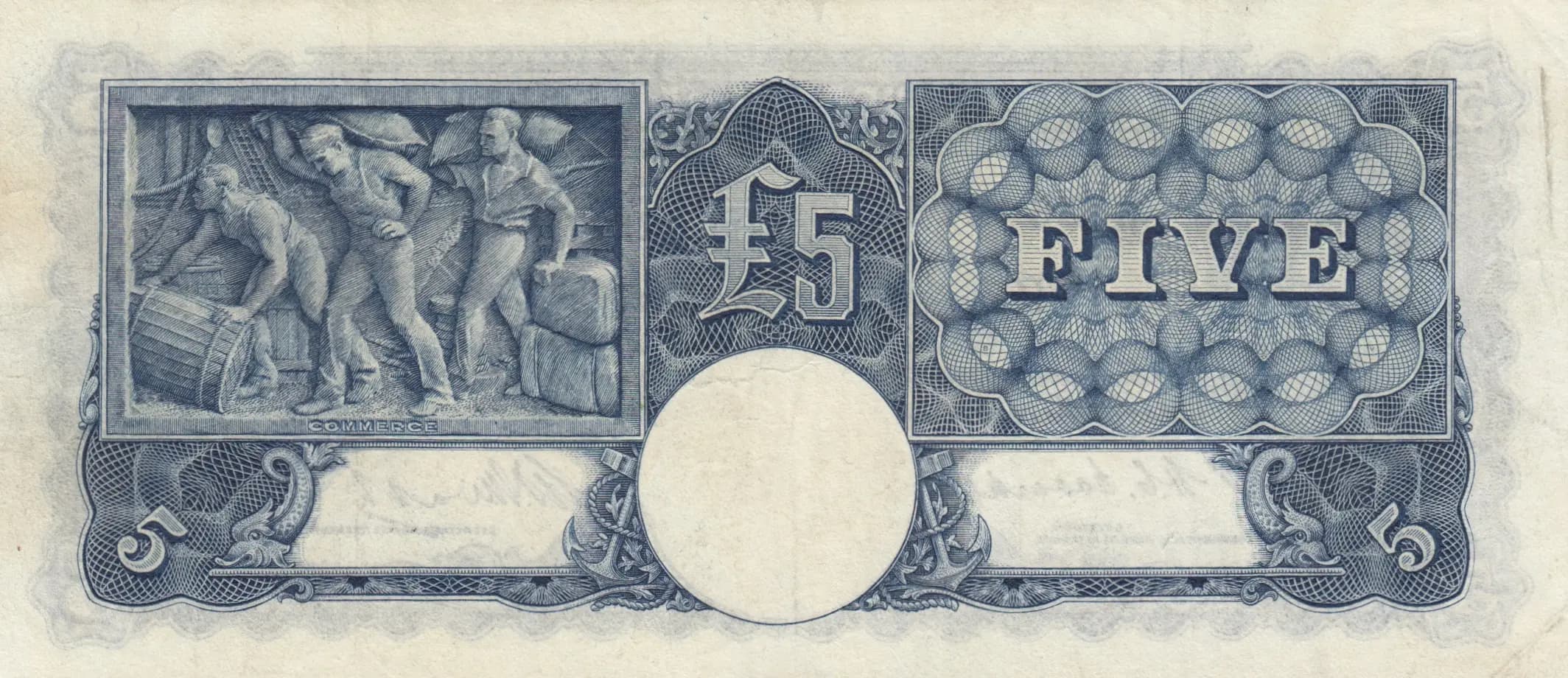
This is an EF-graded Commonwealth Bank of Australia £5 note from the 1939-1952 series (Pick-27c), featuring King George VI in formal portrait on the obverse and an allegorical Commerce scene on the reverse. The note displays the characteristic deep blue on multicolor underprint typical of this issue, with visible age-related patina including foxing and cream-colored discoloration consistent with an early post-war banknote. The crisp engraved design remains clearly legible despite circulation wear, making this an attractive example of Australian monetary history.
Common. While this is a pre-decimal Australian note with inherent collector interest, the 1939-1952 series was issued in substantial quantities. eBay market data shows consistent sales ranging from $53 to $730 depending on grade and certification, with EF examples (matching this note's grade) selling for approximately $113-$130 in recent years. The catalog value for EF is approximately $113.50 based on recent auction activity, indicating normal demand and supply for this issue. No evidence of limited mintage or short-run status exists for P-27c.
Issued during the Commonwealth Bank of Australia's tenure as the nation's central bank, this note reflects the post-war monetary landscape of the 1940s, with King George VI's portrait reinforcing Australia's continued Commonwealth ties. The allegorical Commerce scene on the reverse symbolizes the economic and trade activities that were central to Australia's post-war recovery and development. The signatures of H.C. Isaacbs (Governor) and R. Hart (Secretary to the Treasury) authenticate this note during a critical period of Australian economic stabilization.
The obverse features a formal portrait of King George VI positioned within an ornate oval frame on the left side, rendered in the classical engraved style befitting a Commonwealth monarch. The right side displays the Australian coat of arms within a matching ornate oval frame, symbolizing national sovereignty and authority. The note employs extensive decorative scrollwork and geometric borders in all four corners, with fine cross-hatching and mesh patterns throughout providing anti-counterfeiting complexity. The reverse depicts an allegorical representation of Commerce—multiple classical male figures engaged in commercial activities—positioned on the left, with the large denomination prominently displayed on the right. A circular blank area (likely reserved for watermark visibility) occupies the center of the reverse design.
FRONT: 'COMMONWEALTH OF AUSTRALIA' (Issuing authority); '£5' (Denomination); 'This Note is legal tender for FIVE POUNDS in the Commonwealth and in all Territories under the control of the Commonwealth.' (Legal tender declaration); Serial numbers: '25 764219 S' and 'S 764219 25' (Unique identifier); 'GOVERNOR COMMONWEALTH BANK OF AUSTRALIA' and 'SECRETARY TO THE TREASURY' (Official titles); Signatures: 'H.C. Isaacbs' and 'R. Hart' (Authorized signatories). BACK: 'COMMERCE' (Allegorical theme label); '£5' and 'FIVE' (Denomination).
Intaglio (copperplate engraving), the standard security printing method for Commonwealth Bank of Australia banknotes of this era. The fine line work, cross-hatching patterns, and complex allegorical imagery are characteristic of high-security intaglio production. The note exhibits the deep impression and fine detail typical of this technique, with no evidence of lithographic or other methods.
This note is catalogued as Pick-27c, one of four variants (P-27a through P-27d) all sharing the Captain Cook watermark. The variant designation relates to signature combinations and minor design differences across the series' production run (1939-1952). The observed signatures—H.C. Isaacbs and R. Hart—are consistent with notes from the late 1940s production period. Serial number format and prefix 'S' are standard for this variety. No major overprints or commemorative markings are visible.